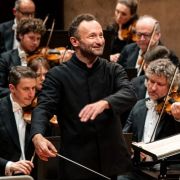
When asked about an ‘ideal scenario’, many of us will have examples of what that entails at the ready, such as a perfectly whisked homemade mayonnaise, or Serena Williams playing tennis. Among these, Kirill Petrenko on the podium of the Berliner Philharmoniker would also be a likely popular choice, nearing unanimous acclaim if the concert were to include a virtuoso soloist playing a beloved, heart-on-the-sleeve piece.

As luck would have it, Petrenko’s latest run of performances at the Philharmonie made this scenario easily attainable. Interestingly, the three pieces the conductor picked for the occasion – Stravinsky’s Pulcinella Suite, Tchaikovsky’s Variations on a Rococo Theme with cello superstar Gautier Capuçon, and Beethoven’s Second Symphony – centred the composers’ fascination for their predecessors near and far.
As the harbinger of Stravinsky’s ‘Neoclassical period’, Pulcinella is a good case of wearing the costume before it becomes the clothes. Later pieces in the composer’s oeuvre may be more convincing in their re-elaboration of classical elements; nonetheless, Pulcinella is a fine costume, immediately striking and fitting for the character.
Petrenko had Stravinsky’s orchestration on his side, an exercise in theatrical zest which brought the audience to a few giggles here and there. From the exchanges between the solo violin and oboe in the Serenata to the trombones and double basses in the Vivo, everyone in the ensemble had the chance to introduce themselves to the audience, making the Suite a great choice to open the evening. Even in the most typically Baroque sections, like the back-and-forth between soloists and concerto grosso in the opening Sinfonia, Petrenko came in with hints of that rhythmic insistence that’s distinctive of Stravinsky’s works for the Ballets Russes. Such insistence only grew throughout the piece thanks to the string section, which gradually lost any pretence to sound Baroque and turned dry, almost curt – but always in jest.
Things turned more serious with the Variations on a Rococo Theme. Here, too, historical inspiration is just the starting point for a path that trails off from Rococo, leading into Tchaikovsky’s clearly Romantic idiom. Needless to say, Capuçon was the star of the show. What better match for the score’s melodicism than a warm, swooning cello?

Listening to Capuçon feels like watching a sculptor chisel. Broader gestures were refined by small strokes, with the sound always remaining rich and soaked in vibrato. A sensible use of ritardandos and control over dynamics helped Capuçon glide into the softest pianissimos. Indeed, the messe di voce and filati could have come from any of Tchaikovsky’s operatic heroines, using Petrenko’s orchestra as a confidant. It was what I could only call an extroverted type of introversion: absolute command of the instrument, which made the performance perfectly lyrical and just occasionally saccharine.
As one of Beethoven’s last early works, the Second Symphony reminds me of the type of young dog with large paws which guarantee that it will grow into a big adult, but who isn’t quite there yet. Petrenko chose to focus, so to say, on the paws. Speedy tempi in the first movement made the main subjects all the more incisive, giving them a characteristically Beethovenian plasticity. Throughout the development, too, the thematic weave remained clear and compact and the orchestra firm. Just somewhat languishing in the Larghetto, the conductor got back on track with the last two movements, where the entire Philharmoniker – especially strings – joined in a triumphant finale for Beethoven and Petrenko alike.