“The great masterpiece you've never heard”. That’s how Sir Simon Rattle has described Schumann’s Das Paradies und die Peri, a work he has championed over the past decade. Schumann himself thought sufficiently highly of it to claim that he had poured his lifeblood into its creation. So what is this creation? Even defining its genre can be tricky; certainly not an opera (despite Schumann’s original desire to conceive it as such), it functions as a sort of secular oratorio, though the composer preferred to describe it as Dichtung (poem).

While its length and logistical demands are considerable, its unfamiliarity may also have something to do with the cloying sentimentality and Orientalist exoticism of the libretto, adapted from Irishman Thomas Moore’s once wildly popular Eastern romance Lalla Rookh. A hit two centuries ago, certainly. Moore’s text has not aged well; it is littered with clangers such as: “There is magic in each tear, gentle spirits; weep for mankind.” And although surtitles were clearly displayed above the choir balcony, they served less to enlighten than to provide a toe-curling distraction, drawing attention to Moore’s purple prose rather than Schumann’s glorious music.
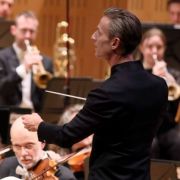
Captivating as Schumann’s music is, it was a bold choice for the Principal Conductor Designate of the National Symphony Orchestra Ireland, Alexander Shelley, with which to open his tenure, as the work presents many kinds of complex challenges – stylistic ones, differing emotional registers, not to mention the balancing of the huge forces of both orchestra and choir with the seven soloists. Shelley emphasised the dramatic elements, allowing the score to unfold with momentum and shaping it into a coherent narrative arc. In the first part there was an almost proto-Wagnerian sweep to the music that stressed the theatrical over the spiritual. By the second part he had moderated to a more reflective style.
There were shortcomings too, most notably in the balance of forces. Particularly in the first part, three of the soloists — Nardus Williams, Robin Tritschler and Rihab Chaieb — struggled at times to project over the orchestra’s weight. The transformation after the interval was striking: voices opened out with greater freedom, and Shelley rebalanced the orchestral sound with far more care.
The Peri, an elfin-like child of the air, has a demanding role where she has to fail twice before attaining Paradise on the third go. The distinct advantage of failing multiple times is to allow three different types of death scenes: the first, militant, the second, loving, the last one, transcendental. Possessing a lyrical, light-timbred voice, Williams gave a thoroughly expressive account of this mythical fairy-child, at her most impressive at the end of the second part as her pianissimo high notes floated up delightfully.

Tritschler’s narrator brought finely focused energy, his clear Baroque-leaning timbre cutting through the texture with ease, especially in the upper register. His elegance and restraint contrasted with the sultry tones of Chaieb who radiated warmth as the Angel. Anna Devin sang her one solo with touching simplicity, marrying strength and brightness particularly in her upper range. The other soloists, Mark Stone, Eiméar Harper and Emma Power, sang with beauty and authority.
The NSOI Chorus was at its most convincing in the blazing climaxes of Part 1 and the final pages, where the music’s exultation finally erupts in full force. Tenors occasionally sounded strained in Schumann’s punishingly high fortissimo writing. These were offset by the overall tenderness of the death scene in Part 2 whose magic hovered in the air for several seconds after the final sounds had vanished.