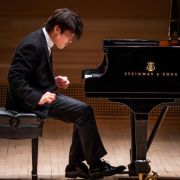
A little over a year after presenting his widely hailed marathon program of Ravel’s complete solo works for piano at Carnegie Hall, Seong-Jin Cho returned to the Hall to deliver an expertly crafted, exquisitely performed program of works by J.S. Bach and three of that composer’s strongest admirers: Schoenberg, Robert Schumann and Chopin.

The recital began with a splendid rendition of Partita no. 1, a seven-part suite famously published as Bach’s Opus No. 1. The opening Prelude and Allemande felt wonderfully lighthearted and festive. Cho’s elegant, expressively flexible playing was a constant joy throughout. The cleanly articulated Courante had an invigorating rhythmic vitality, while the central Sarabande displayed deeply quiet dignity, its ornaments emerging naturally and unforced. After a gracefully poised account of the Menuets came a light and cheerful rendering of the Gigue, its hand-crossings executed with seamless precision, making the dance seem completely airborne.
Next, Cho leaped 200 years ahead to the musical world of Arnold Schoenberg. Composed between 1921 and 1923, the Suite for Piano, Op. 25 is both a revolutionary milestone (the first work in which the composer deployed his 12-tone technique throughout) and a set of stylized Baroque dances. With its clear rhythmic patterns and echoes of the Baroque Suite, it is considerably more accessible than his later serialist works. Cho’s vibrant, vigorous delivery of the work’s six movements – an energetic Präludium, a sparkling Gavotte, a wryly detached Musette, an impassioned Intermezzo, a graceful Menuett and a lively concluding Gigue – countered the music’s reputation as being overly rigid and purely academic.
The recital’s first half ended with a move to 19th Century Vienna. Robert Schumann’s Faschingsschwank aus Wien, a romantic depiction of scenes from the Vienna Carnival, was written during his 1839 stay in the Austrian capital. A mercurial piece that merges festive imagery with political satire and personal longing, it is mostly high spirited – especially in the opening Allegro, which depicts a bustling street parade featuring a mischievous quote from “La Marseillaise” (a work banned at the time due to its revolutionary roots), the sprightly Scherzino, and the triumphant Finale. By contrast, the emotionally intense Intermezzo reflects the composer’s deep longing for his future wife, Clara Wieck, from whom he was separated while in Vienna. Cho’s dramatic performance brilliantly conveyed these varied episodes and mood shifts and managed to sustain a cohesive narrative across all five movements.
The second half of the program was given over entirely to Chopin, whose music has been closely connected with Cho since his 2015 win at the career-paving International Chopin Piano Competition in Warsaw. The pianist played 14 waltzes of his own choosing, arranged in a non-chronological order to produce a highly effective musical sequence. Starting off with three of the faster waltzes – the E Minor, Op. posth.; the F Major, Op.34 no.3; and the universally recognized “Minute Waltz” (D-flat, Op.64 no.1), he then moved into slower selections. One of the many high points was his deeply poetic rendering of the melancholic A Minor, Op.34 no.2. Placed midway in the sequence, it offered a moment of contemplative calm amidst the lineup of more virtuosic pieces, including the feverishly intense A-flat, Op.42, and Op.18, the technically impeccable Grand valse brilliante in E-flat, which concluded the set.
Cho played two encores: an exquisitely delicate account of Chopin’s Nocturne in B-flat Minor, Op.9 no.2 and Alfred Grünfeld’s Soirée de Vienne, a concert paraphrase of waltz motives from Die Fledermaus and other works by Johann Strauss II.