Has Dmitri Shostakovich become the new Rachmaninov in Singapore? There have never been more performances of his music in Singapore within such a short space in living memory. Two weeks ago, the Singapore Symphony Orchestra scaled his Eleventh Symphony with Eliahu Inbal conducting, and the First Piano Concerto followed with Yeol Eum Son’s brilliant fingers a week later. The Fifth Symphony will be heard from the Yong Siew Toh Conservatory Orchestral Institute in two days’ time, and under SSO’s Music Director Designate, Finnish conductor Hannu Lintu, two blockbusters attracted audiences of the size that would usually flock to Rachmaninov evenings.

What packed them in was the Soviet era-composer’s blend of 20th century modernism, dissonant but ultimately tonal, with communicative raw emotions identifiable with contemporary living. Rawness and grit, as opposed to Rachmaninov’s lushness and opulence, also found receptive ears. There was no virtuoso more suave than Greek violinist Leonidas Kavakos for the Violin Concerto no. 1 in A minor, Op.99, composed in 1947. The opening Nocturne pitted low strings against the high line seamlessly established by Kavakos, whose clear and incisive tones sang out like a voice in the wilderness. The bitterness expressed, followed by lashings of vitriol in the Scherzo, where violin battled spiky woodwinds in a hammer-and-tongs struggle, would be suppressed until after Stalin’s death in 1953.
The concerto was clearly about a man against an oppressive totalitarian system, which the original dedicatee David Oistrakh fully understood. Kavakos, despite his cool approach, was never at odds with this, and the ensuing Passacaglia reinforced its gravity. There was a long pause for effect before the searing solo cadenza which launched inexorably into the finale’s Burlesque. In its frenetic pages, the baton flew out of Lintu’s grasp, landing in front of Kavakos who returned it, to the mirth of the audience. That was a brief moment of comic relief amid the flailing Klezmer-influenced mayhem which brought the concerto to a explosive close, greeted by a chorus of cheers. Kavakos’ encore of the Loure from J.S. Bach’s Partita no.3 in E major, BWV1006 provided the perfect balm for the frayed nerves that had come before.
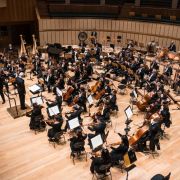
The evening was completed by Shostakovich’s longest symphony, the Seventh or Leningrad, composed during the thousand-day Nazi siege of the city where a million souls perished. Should this be regarded as absolute or programme music, or propagandist hubris for a wartime cause? Lintu and his charges let the music speak for itself, with sound production being the primary agenda. To this end, four French horns, three trumpets and three trombones were placed in the gallery behind the orchestra for maximal projection – and it worked. Seldom has there been a more clear-headed performance of the music, with its themes well-delineated and never strained beyond incredulity. The battle depicted resistance not so much against Fascism but against the banalities of vulgarity.
That infamous first movement invasion theme (based on either Lehár or Tchaikovsky, later parodied by Bartók) and its ensuing crescendo were built up organically and ratcheted to an ear-lacerating climax. Guo Siping’s plaintive bassoon solo provided the desolate denouement. After the exhausting half-hour mark, the central slow movements provided relief despite interludes of upheavals for contrast, and it was the finale which picked up from the opening movement’s exertions. The transition to C major at its conclusion provided the final redemption for the city which “Stalin destroyed and Hitler finished off”. The 78 minutes were a journey well spent. If this show of passion and commitment cannot stir zeal and interest in Singapore for arguably the 20th century’s greatest composer, nothing else will.