The ghost of Maria Callas waits for you in the pine trees. Before you reach your seat at the Ancient Theatre of Epidaurus, the installation at Callas Point has already set the evening's terms. On this stage, 65 years ago, Callas sang Cherubini's Medea in a now-mythic production. This staging reconstructs that legend, although the programme prefers "re-imagining": no video of the original survives, the staging directions only in part. The question you carry to your seat is whether the evening can break free of that ghost, or only kneel before it.

For most of the evening, the production stood its ground. The set blended into the ancient marble behind it; where a lesser staging might have curdled into a musty vision of antiquity, this one felt lived-in, earned by the stones around it. The costumes had been rebuilt in historically accurate fabrics, a challenge noted by the designers, and at the centre was the belt Callas wears in every surviving photograph of the 1961 run. The lighting worked with the dying daylight rather than against it, the sky moving from amber-blue to a star-scattered black by the time the temple burned, and as the light drained, the shadows on stage sharpened with the drama.

Epidaurus is a strange, demanding host for opera. When the orchestra began, the sound surprised: without a hall's enclosing acoustics, half the music seemed delivered skywards, to the gods. The woodwinds carried best, and at moments a voice on stage fell into something like a duet with the oboe in the pit. Under Jacques Lacombe the orchestra fared well, the players visible from every seat, their synchronised breathing lending the evening a bodily quality the chorus echoed from the stage. Built for an age when the chorus stood at the centre of the drama, the theatre felt grandest in its choral passages.
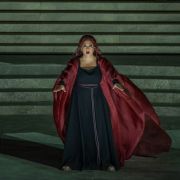
The weight of the evening settled, inevitably, on Anna Pirozzi. Her presence was felt before she opened her mouth: a shadowy figure, at once woman and demigod, who seized the eye midway through Act 1 and then, the moment she sang, seized everything else. "Ah! quale voce," Giasone declares. And, indeed, it was a surprise, uncannily close to Callas in timbre and a classical poise rare today. A ghost twice over, within the story and around it.

The supporting cast held its own. Tassis Christoyannis brought regal presence to his role debut as Creon, although his voice no longer quite matched the bearing. For all his technical control, its want of power was most exposed beside Pirozzi, shown most fully where Medea begs him for a single day's reprieve. This was a moment that should have shown the demigod debasing herself before a mortal man, earning, however briefly, our pity. Yet she never looked like a victim.
Danae Kontora's Glauce suited the part, her fragility conveying a girl caught between her father's will and an older woman's wrath; her duets with Jean-François Borras's Jason had real chemistry. Best of all was Alisa Kolosova's Neris; the way her voice and Pirozzi's wound around one another, each carrying a different weight, was mesmerising, making it believable that Neris alone might stay Medea's hand.

Yet, for all its well-oiled parts, the evening felt like a train that never reached its destination. I had braced to be devastated by the final act, but that never happened. Pirozzi's singing here was secure and technically correct but short of the emotional range the role demands. The closing scene asks the soprano to make audible the whole argument inside Medea: the impossible choice between mortal mother and demigod, between love and the need for vengeance.
Here, the ghost the production had so deliberately summoned became unavoidable. I never heard Callas at Epidaurus – almost no one alive did – but I watched Pirozzi deliver this same climax three years ago, in Greek National Opera's new David McVicar staging, where the ghost was less completely conjured. In Epidaurus, wearing La Divina's belt, she could not quite lift it. Stripped of everything that should have built towards it, the climax gave way under its own strain.

The present kept leaking into the past. As Medea and Jason confronted one another, a small bat flitted across the stage; in the final act, as the 14,000-strong theatre fell silent, the hush was broken by a drone overhead and a nervous giggle ran through the crowd. We were not, after all, in the 1960s, and no amount of reconstructed costumes could summon back the world that made the original, or the singular artist at its centre.
It was hard not to feel for Pirozzi: what a thing to stand in the spot of Callas, wear the costume of Callas, sing the part of Callas, yet not quite be Callas. Greek National Opera proved it has everything needed to honour its myth. The one thing it cannot manufacture is the once-in-a-century voice the original possessed.