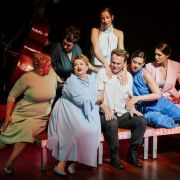
It’s a year of endings and new beginnings both: the 20th outing of Wagner Days in Budapest brings founder Ádám Fischer’s last full account of the Ring cycle and, bookending the festival, a new staging of Parsifal consecrating the concert hall. “Staging” is somewhat generous a description, but “consecration” is not: Birgit Kajtna-Wönig’s production works as a reverent love letter to the festival’s forces.

The orchestra is moved from the pit to the stage (with some expectable and obvious drawbacks in terms of balance), their literal elevation also lifting them symbolically up into the ranks of the Grail’s brotherhood, with the squires saluting them during the Verwandlungsmusik. Seating assistant conductors (and twin brothers) Johannes and Paul Marsovszky at the stage's corners served both as a practical solution given the stage’s set-up, allowing them to cue the singers during trickier passages, and as a further means of integrating the musicians into the drama, having them act alongside the singers in Acts 1 and 3 (but appropriately missing from Klingsor’s castle in Act 2). Props, sparsely used and simple in their symbolism, also involved concert equipment boxes, including one (carefully labeled “Fragile”) as the Grail’s own shrine, furthering the evening’s concert-hall-as-Montsalvat concept. The final coup de théâtre had Kundry uncover the Grail, lighting up the entire concert hall before its own light faded.

It was certainly an effort to make the most of minimal resources at hand, but also a smartly, earnestly and movingly directed semi-staging. And what could have easily been a scenic dud given the stage’s constraints, regardless of a solid concept, was pulled off with vividly drawn, well-acted Personenregie, effective positioning and movement of the chorus, and some outstandingly smart, striking blocking, to the immense credit of Kajtna-Wönig and all musicians involved.
Musically, this Parsifal was not always equally arresting, though Fischer conducted the Hungarian Radio Symphony Orchestra with an assured hand, drawing a reliable performance (though with some occasional, rather rough waywardness from the brass). Act 1 stood out in its intensity and radiant spirit, with Fischer favouring swift tempi and a sweeping fluidity of phrasing, crafting a tightly paced, engrossing reading. Act 2, though searing at times, lacked the same force and structural clarity, bettered on both accounts by an Act 3 that was full of ache and yearning, but never quite reached the same degree of reverent awe on its road to salvation that Act 1 so readily and magnificently inspired.

The cast, practically all festival regulars, offered respectable performances across the board. Magnus Vigilius’ boyish appearance and bright, piercing tenor both lent themselves well to the figure of the pure fool, giving quite a commanding “Nur eine Waffe taugt”, but his diction would often mush and his voice tended to stray off pitch under pressure. Anja Kampe was a force to be reckoned with, wild and mocking in Act 1, captivating in both her despair and her irresistible charming in Act 2, and highly moving and sympathetic in a more generously portrayed and less abasing Act 3 redemption. Vocally, the top of Kampe’s voice retains considerable power and warmth both (and quite some steel: her “Lachte” was explosive), and she offered a sensitively phrased, compelling “Ich sah das Kind”. The strength of her lower registers are, however, another question.
Among the brotherhood of the Grail, Till Faveyts’s warm timbre and textual attention lent nobility and gravitas to Gurnemanz, tirelessly engaging in his acting and singing both. Unfortunately, by virtue of the role’s considerable stage time, he also caught the brunt of the torrent unleashed by having the musicians onstage, his rather lyric bass struggling to project over the orchestral outbursts. Wolfgang Koch’s Amfortas, suitably pained and bitter, was initially beset by a heavy vibrato and similarly struggled to project, but found his footing for Act 3, delivering a gripping performance. Kurt Rydl’s Titurel sounded very credibly near death in his first lines, but gained considerably in stature and volume afterwards. Jochen Schmeckenbecher’s generous baritone was almost too appealing in tone for Klingsor, but he snarled and sneered with conviction.

Among the smaller roles, Balázs Bán's Second Knight was a clear standout with an impressively imposing young bass, in an effective camaraderie with Balázs Papp’s similarly commendable First Knight. The Flowermaidens were appealingly sung by the cadre of Lilla Horti, Laura Topolánszky, Klára Vincze, Beatrix Fodor, Andrea Brassói-Jőrös, and Zsófia Kálnay. Heartfelt laudation is due for the titanic work of the Hungarian Radio Symphony Choir, the Hungarian Radio Children’s Choir, and the Hungarian National Choir, ever so resplendent in tone and unwavering in their dramatic commitment.