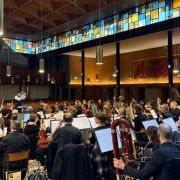
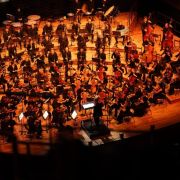
If jazz is America's classical music, guitar overdrive (with apologies to Bernstein, Feldman and Glass) is New York City's. From the symphonic strains of Lou Reed's 1975 feedback masterpiece Metal Machine Music to players from Pat Metheny to Johnny Greenwood recording Steve Reich’s Electric Counterpoint, the plugged-in six-string is the sound of the city. No one capitalized on that better than Glenn Branca, whose electric guitar orchestras found critical mass in large assemblages of the instrument. His Symphony no. 13 (Hallucination City) for 100 guitars and drums was brought back last week for Lincoln Center’s Summer for the City festival, selling out David Geffen Hall on the first day tickets (for a mere $5) were available.


As prelude, three pairs of guitarists from the ensemble played short takes on a piece by another radical New York composer, providing a Fluxus connection even if the composer has more often been associated with hippy protest rock. Thurston Moore and Yoko Ono's Pelvic Noise instructs performers with guitars cranked to embrace, smashing strings and grinding pick-ups, squeezing out brief blasts of noise.
Electric guitars, in fact, don’t want to be quiet, and their hum filled the room with anticipation as conductor Reg Bloor approached the stand for Hallucination City, marking the first time she'd conducted her late husband and bandmate's music. With a count off by the evening’s timekeeper — the impeccable drummer Greg Fox (formerly of black metal band Liturgy) — a grind commenced that could only be described as no-wave minimalism, a four-count with players falling in on different beats, then in a double-time strum.
The composition wasn’t in the structure so much as it was in the velocity, the audacity – it soon became a glorious roar. The second movement dealt with hovering tones and harmonic relations. The third put shifting counterrhythms over a more complex drum pattern that blasted back to 4/4. There were many variations within what seemed on the surface like an army of pile drivers. Everything happened within the 4-count, but what happened on the downbeats, the half beats, in the residual howl was always in flux. It quite literally rolled within its own punches.
In practice it was a rock show, with not just the controversial clapping after movements but full-throated cheering. Ushers walked the aisles like airline attendants, offering individually wrapped earplugs. Before the second movement, Bloor fiercely motioned to the players not to waste time tuning. Before the fourth, she drew laughs by turning to the audience and asking if it was loud enough. Each body in the slow trickle of souls moving for the exits was another person who’d tried something new.


Was it loud enough? Well, it was Lincoln Center loud to be sure, although nowhere near the power drone duo Sunn O))) who played the same stage in 2024. It was easy to hear how Branca’s aesthetic gave rise to the glorious experiments of Sonic Youth (guitarists Thurston Moore and Lee Ranaldo (who was in attendance) met in Branca’s ensemble, even if they named themselves after the MC5 guitarist).
The build over 70 minutes was brilliant. The fourth movement rose to glory like a one-chord Beethoven finale. But the payoff was in the sonic shimmer of thin strips of steel, in the overtones and difference tones and sonic holograms that seemed to rise above the players, like a single spirit departing 101 bodies. It was deep and exultant immersive listening. Like the quiet of Salvatore Sciarrino or the space of Jürg Frey, it’s something not truly experienced until you’ve been in a room with it.