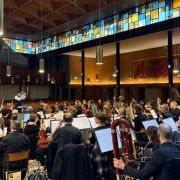
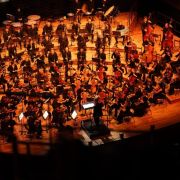
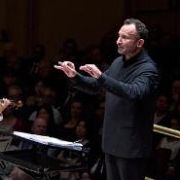
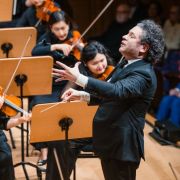
Artistic Director and Chief Conductor of the Czech Philharmonic, Semyon Bychkov, a frequent guest with the New York Philharmonic, returned to Geffen Hall this week to conduct a triumphant finale to the orchestra's subscription season: a robust, highly satisfying account of Anton Bruckner’s Eighth Symphony. A colossal work, it is the last symphony the composer completed, something he did not only once, but twice, first in 1887 and then again in 1890 – the second time shorter but scored for a larger orchestra. For this Philharmonic performance, Bychkov relied on the briefer, more tightly controlled version edited by the eminent Austrian musicologist Leopold Nowak in 1955.


The sole work on the program, with more than 80 minutes of playing time, it is the longest of Bruckner’s symphonies. Extremely demanding for both players and listeners, it easily made for a full evening of music. Though cast in the customary four movements, it was conceived on a massive scale and displays all the characteristics of the Austrian composer’s daringly bold symphonic style – Wagnerian-like horn calls, hymn-like brass chorales, commanding climaxes, leisurely development of themes and a complex, monumentally scaled finale. An oversized orchestra, expanded to include extra strings, triple woodwinds, eight horns (four doubling Wagner tubas), three trumpets, three trombones, a tuba and three harps (the only use of the instrument in a Bruckner symphony) provided the required heft.

Bychkov took a strong, straightforward approach to Bruckner’s masterpiece. Boldly projected from the beginning, with rousing sounds from the brass, the long Allegro moderato first movement, taken at flexible tempos, unfolded steadily and briskly. Tuttis were remarkably well balanced, even at their loudest, with the warm, voluminous strings offering refined contrast. The relentlessly rhythmic Scherzo was equally fleet footed, with the harps establishing a sense of dreaminess in the radiant trio section. The heart of this symphony is the sprawling Adagio, and Bychkov’s direction was admirable throughout. Masterfully pacing the long paragraphs over the movement’s substantial span while eliciting transparent textures from the sweepingly expressive strings, multi-voiced woodwinds, bright brass, and celestial sounding harps, he delivered a particularly fine movement, tinged with dark and tragic feeling. The sturdy finale was equally successful, with the dramatic timpani, sparkling woodwinds, and big brass forces creating a noble and glowing texture as they built to the blazing concluding bars.