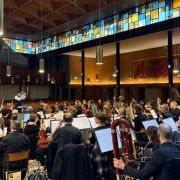
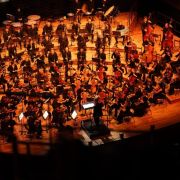
This Sunday ‘Icelandic Chill’ evening at the Barbican Centre will be remembered as one of the most bewildering concerts I’ve ever attended. The reason? An odd choice of programming, destined to collapse under its lofty ambition of defying genres and making music more appealing to a wide variety of audiences, while leaning perilously close to an exoticising rhetoric, where nature and the volcano become a common denominator for all Icelandic music. Sadly, the result was less a productive clash of aesthetics than a mismatch of style and quality that ultimately produced a grey sludge of snow and ash – material that might have made sense in a different context.

Under the baton of Christian Karlsen, the BBC Symphony Orchestra opened with the world premiere of Ólafur Arnalds’ Another Kind of Peace, an orchestral arrangement by Viktor Orri Árnason of Arnalds’ 2020 album Some Kind of Peace. Lulling strings and harp chords grew into pulsating textures, though their repetitive, loop-like nature prevented any sustained interest. There was no bite to the music, my mind drifting in and out. While the piece ticked the first part of Brian Eno’s oft-quoted definition of ambient music – that it “must be able to accommodate many levels of listening attention without enforcing one in particular” – it failed to meet the second: “it must be as ignorable as it is interesting”. The lukewarm response from the audience suggested this was a shared feeling.


The second piece, Daníel Bjarnason’s I Want To Be Alive, certainly enlivened me through its muscular force, peculiar instrumental textures, including drumming on what appeared to be ceramic flower pots, and contrasting characters across a spiky first movement, a serene second and a groovy third with its almost impending sense of doom. The piece was executed effortlessly by the orchestra in both loud and quiet sections; their playing remained controlled throughout the concert. Though the compositional and arranging skill was palpable, the music took me on a journey whose destination remained unclear, with one foot in a modern tradition and the other mired in a romantic idiom.

The highlight of the evening came after the interval in the form of Bára Gísladóttir’s double bass concerto Hringla, with the composer herself as soloist. The slow, gradual unfolding of the double bass improvisation over an orchestral drone captivated with every minute shift of texture, from string trills to Euler’s discs rattling in the percussion section, subtly activating the orchestral fabric. Delicate harmonics, frantic melodic figures and sul ponticello gestures were echoed and refracted through live electronics that processed the material in real time. The sublimity of the work lay in its quiet focus and a refusal of a conventional climax, one that was continually deferred, making the whole encounter feel all the more wondrous.
Last on the bill was Valgeir Sigurðsson’s Dreamland Suite, an orchestral arrangement of his 2008 soundtrack for the documentary Dreamland. It began somewhat promisingly with a recording of American folk singer Sam Amidon crooning the Icelandic folksong Grýlukvæði over string textures and electronic beats, which produced a sweetly uncanny effect. There was also a projection of outtakes from Dreamland, showing bird’s-eye shots of Iceland’s magnificent landscapes, though the less-than-ideal lighting – and the resulting quality of the projection – impeded engagement with the visual element. Soon after, the excitement faded: the music began feeding us bite-size ‘moods’ or ‘vibes’ designed to trigger an easy, recognisable response, save for a few rhythmic sections towards the end. More importantly, as with Arnalds’ piece, the music felt ham-fisted when transplanted into an orchestral setting. Perhaps, this uprooting of context serves neither the music nor the listener well. Perhaps, not every piece needs an orchestral arrangement.


While a seasoned listener might have found the concert’s format strange, attempting to juggle too many things at once, my friend and seat-mate, a non-musician, thoroughly enjoyed it – but that’s a conversation for another day. The quest for the democratisation of classical music marches on, volcanic ash blinding its path.