When Ruggero Leoncavallo discovered that Giacomo Puccini was also writing an opera based on Henri Murger’s Scènes de la vie de bohème, it led to a spat in the press and a rift between the two composers. Puccini’s La bohème premiered in Turin in 1896, beating Leoncavallo’s version by a year. History has favoured the former. Gustav Mahler’s verdict was scathing: “A single bar by Puccini is worth more than the whole of Leoncavallo.” Chances to hear Leoncavallo’s are few and far between, but the Teatro Regio di Torino includes a new production by Francesco Micheli in its Verismo Festival.

Leoncavallo is certainly more faithful to his literary source than Puccini and paints his characters with broader brushstrokes. Schaunard (who now has a first name: Alessandro) plays a larger role and has a girlfriend too (Eufemia). Leoncavallo gives more space to the relationship between Marcello (here a tenor) and Musette, whereas Rodolfo (a baritone) and Mimì are almost the secondary couple, although Leoncavallo’s opera also ends with Mimì’s death.


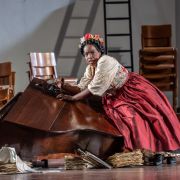
With so many audience heads full of Puccini’s music, one gets the sense that Micheli strives too hard to sell Leoncavallo’s opera as a viable alternative, but his production misses the mark on several counts. Initially, his characters are larger than life, gaudily costumed and bewigged by Giada Masi – along with a band of distracting dancers – in a Café Momus that looks more like a swanky gallery exhibiting Marcello’s floral paintings. These are no impoverished bohemians, but entitled twentysomethings and it’s difficult to know why we should care about them.

A set change that takes an eternity (stagehands have to remove all the canvases) turns the set into a courtyard where Musette’s possessions have been dumped following her eviction. She holds her soirée there instead, the chorus – absent until then – making the most of their appearance in the Regio’s stalls.
Leoncavallo gives Colline even more of a peripheral role than Puccini. Here, though, Micheli presents him as a sort of Father Time figure, carrying an hourglass and singing a couple of French chansons as entr’actes. Colline turns the seasons and, after the interval, the other characters begin to age. Their outlandish costumes are gone and by the time we get to Act 4, the characters could be in a residential nursing home. What this adds to the plot is debatable. Why is the death of Mimì so tragic when she’s already an old age pensioner and the rest of the cast won’t be that far behind her?

The opera has a couple of musical highlights. Rodolfo’s Act 4 “Scuoti, o vento, fra i sibili” is a notable baritone aria and Alessandro Luongo threw everything at it, despite short top notes and the distraction of Colline manhandling him. In Act 3, Marcello’s “Testa adorata”, when he discovers that Musette is leaving him, is a memorable setpiece, well sung by Matteo Lippi, easily the pick of the cast. Lippi has a sunlit tenor that constantly caught the ear.


Baritone Simone Dal Savio was the other bright spot, commanding in both voice and stage presence as Schaunard, while Micheli made the most of Francesco Salvadori’s towering presence as a mysterious Colline, both his a cappella numbers attractively sung, including Georges Brassens’ Les amours d'antan. Soprano Francesca Dotto made for a sympathetic Mimì, tenderly sung, but mezzo Anna Goryachova was miscast as Musette, struggling to make a vocal impact. Manuela Custer made the most of her limited opportunities as Eufemia, while tenor Manuel Pierattelli was a suitably uptight Gaudenzio, head waiter at Momus.

Andrea Battistoni, conducting all four operas in this festival, certainly worked the orchestra hard and drew committed playing from his players, cast and chorus, but this is not a production to argue a convincing case for Leoncavallo.