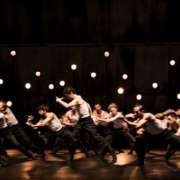
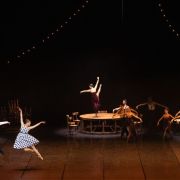
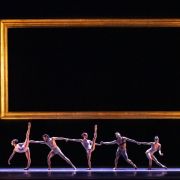
Can a choreographic work be revisited decades after its creation with the very same performers who appeared in the premiere? To what extent can bodily memory preserve the identity of a theatrical work over time? What emerges from such an act of resurrection? How can an exploration of joy, sorrow, and the contradictions of human passion be renewed almost fifty years later? These crucial questions find compelling answers in the vision pursued by Australian choreographer Meryl Tankard in Kontakthof: Echoes of ’78, a new staging of Kontakthof, the historic and iconic work created by Pina Bausch in 1978 in Wuppertal.

As is well known, Kontakthof was conceived to reveal – without a conventional plot or defined characters – the ambiguity, complexity, and spontaneity of human relationships, supported by a musical score drawing on popular songs from the 1920s and 1930s. Set in a dance hall, the work unfolds through gestures, encounters and movements of varying complexity, articulated through a heterogeneous theatrical language that juxtaposes tenderness and violence, the grotesque and the brutal, affection and desire. What returns today are the echoes of that creation, its memories and evocations, as some of the original performers return to the stage. Their presence gives shape to a new version that interweaves projections of meticulously restored archival footage with live performance, achieving a seamless, balanced and harmonious symbiosis between the artists on stage and the images of those who originally brought Pina Bausch’s iconic work to life.


This Bauschian remembrance unfolds as a dialogue between past and present. Presented in Lugano as the closing performance of the tour, it pays tribute to those who dance today within the poetics of the body and embodiment that may appear of another era, yet still conveys an extraordinary poetic and emotional force, distinguished by its expressive depth and evocative resonance.
What do we discover in Echoes of ’78? The performers’ iconic, glassy gazes return, as they guide the spectator along a journey in which melancholy, aggression, tenderness and euphoria are read, relived and experienced anew. It is vulnerability that runs through this version of the original work, which here becomes an intense reflection on the passage of time, on relationships and on absence.
Nothing in Bausch’s writing was ever superfluous and if it is true that, from its very inception, the piece has offered itself as fertile ground for an exploration of time itself, then this new work – although it reduces the original duration – preserves a dialogue and an enquiry that, through dance and theatre, becomes an act of pared-down rethinking, stripped of ornamentation.

Dance and heritage, the two themes chosen for the new edition of the Lugano Dance Project, emerge as authentic and fitting references within this renewed Bauschian vision, which rethinks, reshapes, and re-presents with awareness and sensitivity the essence of the late choreographer’s aesthetic.
If this work returns to the memory of a body in flux, both yesterday’s and today’s, the second piece we encountered appears instead to explore the relationship with music and personal memory. Music Music – Histoire(s) du Théâtre by Trajal Harrell is a long solo that seeks to reveal a deeply personal memory of the role music has played in relation to choreographic creation. The artist, awarded the prestigious Leone d’Argento at the 2024 Venice Biennale, seems to open to the spectator an archive of emotions, memories and lived experiences. The result is a discourse on personal history, on one’s relationship with oneself and on how one speaks in and to the world, between memory and the act of listening. At the same time, the chosen approach appears to rest on observing the artist within an ordinary, everyday and deeply personal experience of dance and performance. Can this be the key to engaging and captivating the audience?


Vito Lentini’s trip was funded by LAC Lugano Arte e Cultura