In a bonkers move, the White House last week registered two new domain names – alien.gov and aliens.gov – hinting that the American president may soon make good on a campaign promise to release previously classified government files on extraterrestrials. Meanwhile, NASA’s Artemis II launches this week, sending four astronauts to orbit the moon, going farther into space than any previous crew. As earthly cataclysms mount, the allure of moon travel beckons anew, with no more captivating guide than choreographer Mark Morris. His hourlong Moon launched in 2025 at the Kennedy Center in Washington, DC. Commissioned prior to the coup that rendered that site radioactive (“like Chernobyl,” said Morris), the project forged ahead even as other artists fled and audiences dwindled. Last week, Moon landed at the venerable Brooklyn Academy of Music: an entrancing, pensive musing on America’s infatuation with the moon.

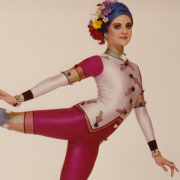
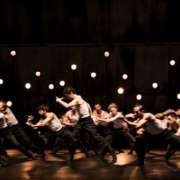
Glorious projection designs by Wendall K. Harrington encompassed footage from space, mathematical diagrams of planetary orbit trajectories, and droll animations. The crisp, austere jangling of Ligeti’s ‘Musica Ricercata’ accompanied the ensemble of nine dancers, clad in Isaac Mizrahi’s idea of lunar playsuits: black on one side, white on the other. Colin Fowler and Milad Daniari on keyboards and bass energised the live score, which included a poignant rendering of Debussy’s Clair de Lune, set against recordings of late Depression-era songs. My favorite was crooner Al Bowlly’s wistful Roll Along, Prairie Moon which occasioned a tender duet.


Adding to the fanciful, near-mystical aura were fragments of sound and voice recordings lifted from the 1977 Golden Record: phonograph discs on which sounds of life on Earth, music and greetings in 55 languages were preserved and stashed aboard Voyager 1 and Voyager 2 in anticipation of an interception by tech-savvy extraterrestrials who might want to get to know us.
As if foreshadowing an encounter with alien life forms, two groups of dancers approached one another warily. Their hands fluttered expressively in animated exchanges before they settled into a ritual embrace, bodies hovering just shy of contact. Before withdrawing, the two group commanders bowed politely to one another. If only real-world Secretaries of War took their choreography from Mark Morris.

In a tribute to JFK – and a wry troll of the new edgelords at the Kennedy Center – his portrait loomed large on the backdrop over the official seal of The President of the United States. It reminded us of Kennedy’s 1962 pledge to put a man on the moon before the decade’s end. After early Soviet victories in space, he reclaimed the narrative, melodramatically casting America’s role as helping to decide “whether this new ocean will be a sea of peace or a new terrifying theater of war.”
In a nod to the 12 Apollo astronauts who have set foot on the moon, the stage was furnished with a dozen toddler-sized moonwalker figurines by sculptor Ottmar Hörl. When the dancers weren’t tumbling gently through space – striding cautiously, tilting side to side; extending a leg as the torso drooped expressively the other way; sweeping their arms in huge curves that set the whole body arcing – they were tasked with repositioning the moonwalkers. At times these stout little figures seemed to gaze through their helmet bubbles at Earth projected on the backdrop; at others, they seemed to gaze out, unnervingly, at us.

The spins and orbits of celestial bodies were evoked in whimsical passages in which dancers coasted on and offstage on rolling stools, lying prone and fluttering their arms and legs like swimmers. Initiating a spin, they arched their spines or crunched their torsos, pulling in their arms and legs to increase their rotational speed, carving beautiful spinning arcs to the otherworldly sounds of Duprés’ Inventions for organ. At other times, walking dancers dragged partners on stools and set them spinning. No one ever crashed. As onstage, so in space: the moon shadows our planet in its journey around the sun, its gentle gravitational pull stabilizing Earth’s tilt and averting the wild climate swings that have stripped other planets of their atmospheres. For nearly five billion years, the moon has been our quiet guardian.


Some of the imagery lands more ominously today than it surely did when the piece was conceived – like the backdrop animation of brightly colored rockets lined up for launch. Yet the otherwise innocent, quirky optimism of Moon recalls the Handel works whose pastoral themes Morris so vividly conjured: in its restless shifts between shadow and light, its fragile joys and contemplative melancholy, and its reimagining of verdant landscapes as craggy moonscapes.
As the stage darkened and the dancers turned their backs on us, my mind went not to Debussy, Ligeti or the perky Gershwin anthem for the 1939 World’s Fair but to Roger Waters addressing the absent Syd Barrett: “I’ll see you on the dark side of the moon.”