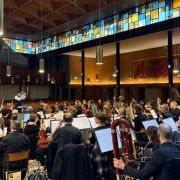
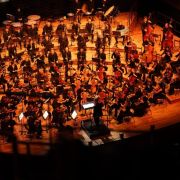
One of the UK’s busiest and most versatile large choirs, the Brighton Festival Chorus is a force to be reckoned with. If you’re wondering why your local choral society is struggling for tenors and basses, this is where they’ve all gone to. Massed like an army together with their soprano and alto colleagues behind the Royal Philharmonic Concert Orchestra at the Anvil on Sunday, they certainly packed a punch. Exactly what you want when you open with Hubert Parry’s ever-popular barnstormer I Was Glad. Basingstoke may still be recovering. It was, as conductor James Morgan put it, “very loud”.


Having successfully blown the doors off, Parry’s coronation anthem for Edward VII gave way to a programme of Elgar: the Cello Concerto in E minor and his 1912 ‘noratorio’ (not an oratorio) The Music Makers. Unique in its use of self-quotation, Elgar’s piece is a sort of musical bingo card, with many of the composer’s best-loved tunes making an appearance, though they are accompanied by an infamously dreadful text by the Victorian poet and herpetologist, Arthur O’Shaughnessy. (To give a flavour, the second stanza hazards the phrase “deathless ditties” before – thank heavens – rhyming it with “the world’s great…cities”.) Nevertheless, the overall message, dear to Elgar’s heart, is a powerful one. While artists have the power to inspire generations, creativity is fragile and the “dreamers of dreams” are destined for solitude.
The inspiration of generations proved no problem at all for the multitudes of the Brighton Festival Chorus and the RPCO all having a thoroughly good time – they will probably still be audible well into next week. Mezzo Elizabeth Lynch’s generous and commanding delivery of the solo line was sometimes lost altogether in the general rouse, but there were moments of exquisite pianissimo too, and it’s to this huge choir’s credit – as it is to Morgan’s – that the delicate vulnerability in Elgar’s vision was almost as impressive as its bombast.


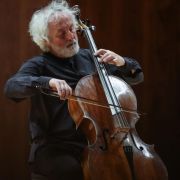
The opening bars of the Cello Concerto in E minor are as iconic an expression of anguish as any art that came out of the First World War: their emotional charge is almost overwhelming. A respected chamber musician and guest principal of the country’s leading orchestras, cellist Adrian Bradbury played a strong ensemble game, making the most of the concerto’s more intimate moments, though from the off he surprised by not quite taking command, leaving him subject to a tempo that felt uncomfortably uniform and which in turn meant that the emotional force of the first movement particularly went a little underplayed.
But the afternoon really belonged to the exuberant partnership of choir and orchestra, and to the spirit of music-making everywhere.