John Cranko’s Romeo and Juliet premiered at The Australian Ballet in 1974, just over fifty years ago: a well-loved story of feud, instant infatuation and quadruple fatalities; the Montagues and Capulets hate each other with impressive dedication and no clear record of why. Expertly choreographed street fights are routine. When Romeo and Juliet fall in love and discover they belong to rival families, in typical defiant teenage fashion, rather than reconsidering they double-down.

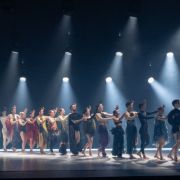
Cranko’s version has established itself as a repertoire favourite and returns in 2026. There’s much to admire. The company as a whole delivers a lively performance. The trio of Yuumi Yamada, Mia Heathcote, and Precious Adams as sassy, charismatic Harlots is a highlight of the production. Adams is a recent gain for the company, having spent many years at the English National Ballet.
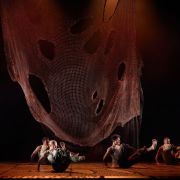
Jürgen Rose’s sets and costumes create a lush, lyrical Elizabethan world. The ballroom scene glows in opulent criss-crossed golds and bronze, lit by candlelight. The famous balcony scene unfolds in silver moonlight, against a streaked sky, Juliet luminous in flowing white. Between these moments come bursts of colour: bejewelled street dancers flicking their scorched orange skirts, and court clowns vivid in purple and gold.


But it’s the Juliet role that must carry the show: demanding acting skill, stamina and technical control, along with a convincing emotional transformation. One of the challenges of ballet companies performing Romeo and Juliet is that their principals are often on the cusp of aging out of the adolescent energy and impulsivity that the titular roles demand. Perhaps this was one of the explanations for soloist Grace Carroll performing Juliet on opening night. At still just 23, the youthful exuberance and vulnerability of Juliet might be expected to come naturally to Carroll. She was paired with the charming but significantly older Joseph Caley, as Romeo.
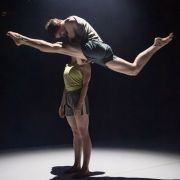
In the central pas de deux, the choreography alternates between hesitation and commitment: with sweeping lifts, bursts on the diagonal and the push and pull of electrifying fish dives. Caley’s silky, spiralling renversés give a sense of momentum and risk. Carroll’s extended arabesques, expansive port de bras and yielding cambrés reflect her emotional unfurling, her movement language widening as she discovers the exhilaration of first love.

While Carroll is a dancer of extraordinary technical ability, with breathtakingly luxurious lines and crisp pirouettes, her emotional restraint feels at odds with the reckless impulsivity that defines Juliet. Joseph Caley, while always a solid performer and generous partner – perhaps a credit to his maturity – lacked the burning, lovesick teenage volatility required. Like Carroll, there was a measure of restraint in his performance; he gives the energy of a sensible accountant rather than an infatuated, blinkered adolescent. Given this ballet lives or dies on the chemistry between its two leads, the partnership between Caley and Carroll is technically secure but emotionally cautious, their interactions marked more by control than passionate abandon. They share the stage comfortably but lack the magnetic urgency that would make an audience believe death is preferable to separation.


Back to the action. Swashbuckling sword fights remain reliably thrilling: Tybalt kills Mercutio. Marcus Morelli is a scene-stealer as Mercutio – mercurial, flamboyant and flourishing. Modern-day crime podcasters would admire his talent for turning death into entertainment. The driving percussion in Sergei Prokofiev’s textured and iconic score mirrors Mercutio’s failing heart. Despite his earlier restraint, Romeo is pushed past his window of tolerance and kills Tybalt; he is banished. The narrative moves with brutal efficiency, but not before Romeo and Juliet spend their first – and last – night together.
When the curtain lifts on the boudoir scene at the start of Act 3, a man in the row behind me helpfully narrates, sotto voce, “sex, sex, sex!,” which I confess I never would have deduced for myself from the sight of two teenage lovers tangled in rumpled sheets at dawn following their secret marriage by the loosest priest in Verona. I fear for any audience forced to navigate such opaque storytelling without his interpretive assistance.

One really must wonder how Friar Laurence ever passed his Working With Children check, given he thought it was a solid plan to secretly marry minors from warring tribes without legal guardian consent, fake a death without following through on essential correspondence, then leave a 13 year old girl to wake up in a crypt next to a corpse. And all with the apparent endgame of social cohesion. The good Friar is essentially the poster boy for those who claim to want peace but cause chaos. Clearly not a man you’d hire in risk management.
While the company’s performance is energetic, colourful and technically sound – at least on opening night – the connection between the two leads remains courteous rather than combustible.