Antonín Dvořák’s Rusalka offers no easy consolations. In Irish National Opera’s new production, director Netia Jones leans into that darkness with a visually striking but uneven modern reimagining. Jones recasts the fairytale through a contemporary lens, exploring the pressures placed on women to reshape themselves, physically and socially. In this dreamlike setting, Rusalka’s yearning to become human becomes less a romantic fantasy than a troubling act of self-erasure. It is a compelling idea, but one that only intermittently convinces, not least because the incessant video projections distract more than they illuminate.

The visuals are nonetheless often arresting. A largely monochrome palette dominates, punctuated by flashes of red in Act 2 to signal the dangerous allure of human passion. The underwater world is rendered through a network of large interconnecting pipes, which allow the acrobatic sprites to move with striking agility. A recurring video image of a fully clothed woman swimming, initially evocative, soon becomes intrusive through overuse, diluting rather than deepening the opera’s atmosphere. More successful is the ballroom scene, where the Prince’s court appears as a regimented assembly of chess pieces, neatly mirroring Rusalka’s inability to navigate the rigid rules of human society.


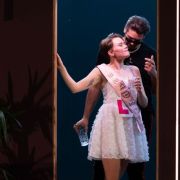
As the eponymous heroine, Jennifer Davis took time to settle but grew in authority as the evening progressed. It is a strange opera in that the main protagonist is silent for nearly all of the second act. Possessing a bright, forward-focused timbre she was at her best in the moments when she sang with passionate regret in Act 2 and 3. Her voice opened out impressively at the climaxes. The famous Song to the Moon was dutiful rather than the emotional knockout it ought to be. Dramatically Davis was very convincing as the newly transformed human, hesitant about how to walk (in stilettos) and unsure of how to embrace the Prince.

Ryan Capozzo possesses a light lyric tenor voice, attractive in colour but lacking the projection needed to ride the orchestral climaxes as the Prince. There was good chemistry with Davis as his voice throbbed with passion in the aria “I know that you are magic”. His acting was excellent whether as a lothario or a regretful, drunken lover.
Ante Jerkunica, as Vodník, impressed with his sepulchral bass. Dressed slightly incongruously as a plumber (tending to all those water pipe sets) he sang with real conviction and heartfelt emotion whether allowing his daughter to become human (Act 1) or pitying her as she is seduced by the trappings of society (Act 2).

Among the supporting roles, Michelle DeYoung’s Ježibaba, reimagined as a chain-smoking cosmetic surgeon, brought a vein of sardonic humour, though her wide vibrato and uneven lower register proved distracting. Giselle Allen made a strong impression as the Foreign Princess, her cutting tone and steely presence lending the character a suitably predatory edge. The three wood sprites (Rachel Croash, Sarah Richmond and Alexandra Urquiola) sang with admirable blend and clarity while the chorus brought weight and precision to the court scenes, cutting cleanly through the orchestral texture.


Fergus Sheil conducted the orchestra with evident enthusiasm and lashings of passion – at times too much so as the orchestra dominated some voices. There was a sense of urgency in the opening cello motifs in the prelude while in the Act 2 interlude there was a snarl and snap to the percussion section.
For all its visual invention, this is a production that convinces more in detail than as a whole. Yet it still makes a case for Rusalka as a work of far greater dramatic bite – even if Jones’ production only intermittently realises it.