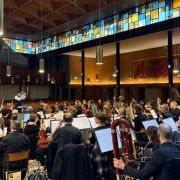
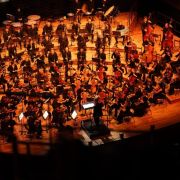
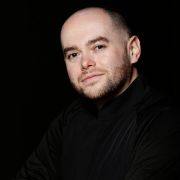
Steve Reich’s 90th birthday celebrations reached a rapturous conclusion at the Glasshouse, Gateshead, with a weekend packed full of concerts, installations, talks and free events dedicated to the composer’s works. Curated by percussionist and conductor Colin Currie and his group, the festival’s two main performances took place at Sage One auditorium on Friday and Saturday.

In the first of several pre-concert talks between Currie and Tom Service, the BBC Radio 3 broadcaster drew attention to the many paradoxes that lie at the heart of Reich’s music, not least – for a composer about to enter his tenth decade, no less – its energetic and youthful life-affirming qualities. Evidence of this could be found in Runner, for large ensemble. Despite being written in 2016, when the composer was 80 years old, the 15-minute work contained plenty of vigour and vibrancy.
Under Currie’s direction, the work’s terraced textures and dynamics were impressively communicated by the Royal Northern Sinfonia, its ethereal ending evaporating as if by magic into thin air. If Runner required musical stamina, Double Sextet demanded dead-eyed accuracy, especially during its fast outer movements. Its slow central section was expressively shaped by Currie's ensemble into a deeply affective almost Baroque-like da capo aria without words.


Another Reich paradox lies between what can be called the ‘hits’ and ‘growers’ in his oeuvre, namely pieces which have made an immediate impact on audiences, such as the ever-popular Clapping Music (also performed in Friday’s concert), and those which have steadily increased in importance over longer periods.
One might include the large-scale The Desert Music, for chorus and orchestra, in the latter category. By Reich’s own admission, the work's world premiere in Cologne in March 1984 was a near-disaster. However, subsequent performances have revealed the work’s underlying value, greatness and significance. The RNS’ absorbing performance was no exception. In this reduced version for chamber orchestra and ten amplified voices (made by Alan Pierson in 2001), the 50-minute setting of texts by William Carlos Williams lost nothing of its power and poignancy. If anything, this version gained more in instrumental and vocal balance.
The Desert Music also benefited from having a conductor with a percussionist’s precise rhythmic and time-keeping instincts. In fact, Currie’s direction provided far more than this, blending voices and instruments to powerful ends, especially in the work's slow middle third section. The brass section’s ominous, snarling low tones vividly captured Williams’ cautionary words about nuclear destruction and annihilation. Currie’s passionate advocacy of Reich’s music was evident throughout, encapsulated at the end when the conductor defiantly held up the score to a rapturously receptive audience.

After Friday evening’s fire-and-brimstone, Saturday’s concert offered a more emotionally uplifting experience, although you wouldn’t have guessed it from the opening piece. Written in 1973, and forming a companion piece to Clapping Music, Music for Pieces of Wood is one of Reich’s more mechanical compositions. Nevertheless, the quintet of clave-wielding percussionists – Currie amongst them – provided a satisfying sense of ebb and flow, which ended with a musical equivalent of a gymnast’s perfect dismount.
With its eye-catching opening statement and dizzying staircase-like antiphonal exchanges between two pairs of pianos and vibraphones, Quartet is another ‘grower’ in Reich’s repertory. Composed for the Colin Currie Group in 2013, the 15-minute work demands high levels of ensemble virtuosity. The quartet – comprising Currie himself, Owen Gunnell, alongside ever-reliable pianists Siwan Rhys and Philip Moore – duly obliged with a punchy, powerful and flawless performance.


And so, to arguably the entire festival’s highlight: Reich’s landmark Music for 18 Musicians. I was fortunate enough to hear several impressive performances of Reich’s minimalist masterpiece during the composer’s 90th birthday year, including Ensemble Modern’s skilfully sculpted rendition in Cologne in January and the Paraorchestra’s refreshingly leftfield take at London’s Southbank last month. However, none of those performances prepared me for this vintage, top-drawer account from the Colin Currie Group. This was a Music for 18 Musicians carved out of subtlety, finesse and conviction: a Music for 18 of supreme Château d'Yquem-like proportions.

A unique feature of the ensemble’s interpretation lies in the way in which vocal and instrumental colours are shaped organically throughout the work’s eleven continuous sections. This was evident from the eleven pulsed chords heard at the beginning, where marimbas, pianos, bass clarinets, voices and strings effortlessly dovetailed and overlapped in such a way as to form gently undulating contours. Other highlights included Section V, with its propulsive piano patterns based on the composer’s earlier Violin Phase, and section XI, where the clarinets and voices shone vividly throughout.
At 90 years old, Reich has reached another milestone, but Music for 18 possesses all the timeless and universal qualities that form hallmarks of a great musical work. In those rare moments, whatever paradoxes we think lie in the music is sublimated into a precious and priceless jewel that only music can provide.