Around 1600, something major was changing in the imagination of European musicians. Keyboard instruments were transforming music from layers of polyphony to something essentially chordal: melody and harmony above a bass. With this change of orientation soon came a new phenomenon – opera.

Harpsichordist, composer and teacher of continuo Thomas Leininger is unusually well placed to reflect on this history. As well as lecturing in performance practice and historical basso continuo at Basel’s famed Schola Cantorum, he is also a composer – reconstructing historical operas, by Monteverdi, Vivaldi and Handel, among others.
Operas of the 17th and 18th centuries were adult affairs: social occasions designed to impress and be seen at. But in later periods, especially from the end of the 19th century, music drama became more culturally inclusive, eventually catering to children and young people. Today, opera for children is quite common – though Leininger’s original composition Les Dinos et l’Arche, which is presented in a new French version with Baroque ensemble Cappella Mediterranea at Geneva’s La Cité Bleue in February, is something unusual.
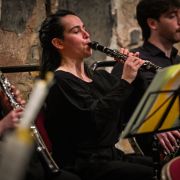
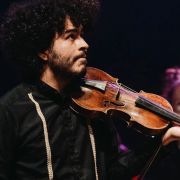
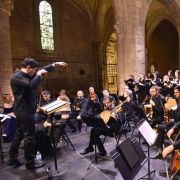
“It’s essentially a re-mix, a combination of different styles, starting from early Baroque until Classical musical language,” Leininger tells me when we speak by video call. The ensemble utilises a rich section of basso continuo, creating a semi-improvised bed against the singers. “We also have clarinets, horns, a celesta, and percussion, so it’s not only a small Baroque group, as you might expect from ‘real’ Baroque music.” Nevertheless, the score often looks similar to Baroque opera: at times, only a vocal line and a figured bass line, with harmony filled in improvvisando.


The piece originated in Leininger’s work with the Badisches Staatstheater in Karlsruhe. “There I did several reconstructions – the biggest was the Montezuma by Vivaldi. More or less half of the opera was lost, and I re-wrote the missing other half. They had the idea of bringing young people to Early music, doing a short Baroque-style piece.” Operas of the 17th century were typically expansive in duration: “this piece is not three hours long! It is about 90 minutes.”
Les Dinos et l’Arche frames its story via Charles Darwin and his pet Galápagos iguana contemplating what must have happened to the dinosaurs in the Biblical flood. How did they miss boarding the Ark? “The dinosaurs, who are really the upper-class of their time, are a bit old fashioned, like aristocrats. They are booking the best places on the Ark, luxury rooms, but at the same time they don’t have modern clocks, they just have their sundials. As soon as it starts to rain, they can’t see the time any more, and then they are too late, and all the places are taken by other animals,” Leininger explains.

These aristocratic sauropods are forced to figure things out on their own – and their aristocratic nature is echoed by the Baroque-infused music. Noble and supernatural persons are naturally ubiquitous in opera of the period, and even the text adopts the period’s forms too. “The libretto, the text, is very inventive,” Leininger says, “and I had the great good fortune to have a translator who wrote their thesis on Baroque opera libretti. (Tina Hartmann is her name.) She knows all the different verse metres, forms – everything that happened during the 17th and 18th century, and she really made a modern text that was playing with all these forms.”
As well as taking its inspiration from Baroque opera, Les Dinos sits in a wider tradition of operatic depictions of sentient animals. From the sly fox of Stravinsky’s Renard, deriving from Afanasyev’s folk stories, to Janáček’s Cunning Little Vixen, the garden creatures of Ravel’s L’Enfant et les sortileges, and Knussen’s Where the Wild Things Are and Higglety Pigglety Pop. Indeed, Oliver Knussen’s collagic, colourful style seems like a natural precedent, considering Maurice Sendak’s hulking prehistoric Wild Things, who set sail with their adopted leader Max – as well as Knussen’s cod-Mozart opera at the end of Higglety Pigglety Pop.
“Actually, I didn’t take any existing work as a model or inspiration,” Leininger says. “Working on the text, creating and putting it into a suitable form for being composed, at that time was really an overwhelming task, and I was just absorbed by this process! I did take quotations from existing music – motives, melodies, from Vivaldi, or Bach, not necessarily very obvious but hidden here and there in the opera. So there are references to existing pieces, but I tried to do it in a funny and witty way.”

Depictions of sentient animals are nevertheless relatively rare in Baroque opera, which prefers nobles, gods, fairies, spirits and muses. Even in Hasse’s oratorio Serpentes ignei in deserto (Fiery serpents in the desert), the serpents are silent. Talking animals were more common in folk stories, and particularly in medieval literature – in Latin ‘beast poetry’ and fables of Reynard the Fox, popular in the 12th century.
Les Dinos does something similar to Britten in Noye’s Fludde, harking back to earlier genres via reference to the Biblical flood story. And Leininger, like Britten, adopts musical techniques of earlier eras, albeit of slightly different periods. Stravinsky, too, gravitated towards the Ark story, in his short television opera The Flood, dwelling on the scaffolding and construction of the ark as collective endeavour.


Leininger and librettist Cédric Costantino’s approach to the story is notably more humanistic. “How can we work together instead of fighting against one another? Also the question of how poetry and music can be part of our lives, to help us solve problems,” Leininger says.

It’s natural that a story about a group of creatures on the verge of extinction should have clear resonances for us today, in the midst of the climate crisis and the Anthropocene, what some have characterised as the sixth mass extinction. When the piece was first written, “this subject was already there”, Leininger says, “but it gained even more importance over the last few years. The climate crisis is part of the text, but the text is also about solving problems together, finding solutions creatively in a desperate situation.
“It doesn’t offer direct solutions, but it is looking to inspire us, how we can work together, to think of solutions no one has thought about yet. Doing things together, working together, and working with creativity – that’s one of the messages of the text.”
Performing as part of a basso continuo group seems to capture elements of this ethos too. The freedom to embellish harmonies, to ornament, and to work together with others as part of an ensemble – all were very attractive to Leininger. “It was one of the reasons, at a certain point in my life, I decided not only to be a pianist but also to study harpsichord. On the piano you can play alone, and it’s fine, or you can play with others with written-out parts – but playing basso continuo is really amazing because it’s the combination of playing and composing at the same time.

“It’s the different possibilities to combine different instruments in the continuo group: the organ, the harpsichord, different types of lutes, harps, guitar, whatever. I think there’s also something fascinating in the sound alone of these instruments: if you hear a Baroque guitar striking one chord, you are already amazed by the beautiful sound of that instrument.”
Continuo practice fundamentally shaped the way that musicians of the 17th and 18th centuries understood musical activity, with unfigured basses, or partimenti, used as teaching aids for much of the period. Musicians would not only need to harmonise a bass, but figure out what it implied: what the upper melodic lines would be. It was a teaching method pioneered in Italy and led to Italian musicians dominating the European musical world, and something Leininger continues in Basel.
“You have a lot to think about”, Leininger says, “not just the harmonisation of every bar, but how to make a good piece out of the whole thing.” Every exercise meant that students were faced with what are compositional decisions – choices which modern instrumental teaching has a habit of excluding. “With this bass, I could play this or that in the right hand, and then you have to consider in which moment to use what. There are so many different combinations or solutions”.
If Les Dinos et l’Arche can capture this freewheeling creativity at the heart of Baroque style, and through music and storytelling introduce it to young audiences, then it seems like something worthwhile indeed.
Les Dinos et l’Arche is at La Cité Bleue, Geneva from 3rd–7th February.
See all upcoming events at La Cité Bleue.
This article was sponsored by La Cité Bleue.