Think of Verdi’s Aida and which word comes to mind? Spectacle. A Triumphal Scene where, if they have the budget, directors stuff the stage with a cast of thousands as the Egyptians parade the spoils of victory over the Ethiopians. But what if that scene depicts the human cost of battle, not just to the defeated, but to the victors too? That’s what Noa Naamat does in her powerful staging opening the new season at Finnish National Opera.

I love a bit of Zeffirelli bling, but most imitations fall short, to say nothing of the risible reimaginings of directors charging Verdi with cultural appropriation. Instead, Naamat’s very different, very earthy approach strikes me as the most dramatically engaging Aida staging I’ve ever witnessed.
There are no traces of pharaohs or pyramids here. In a co-production with Staatstheater Darmstadt, where it played last season, the Israeli director, a former Jette Parker Young Artist at The Royal Opera, doesn’t place the action anywhere specific. The bombed water tower and rubble of her and Bettina Johns’ revolving set could represent any of the conflicts sadly all too familiar from today’s news screens.


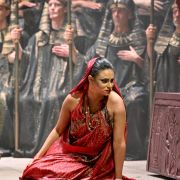
During the prelude, children play hide-and-seek. Parents come to collect them and one mother, fetching her daughter’s doll, is killed in the latest blast. Enemy soldiers snatch the girl away. Thus we learn how Aida ends up in Egyptian hands. In the opera, she lives in the rubble of a bombed-out building, Radamès secretly bringing her water, singing “Celeste, Aida” directly to her face.

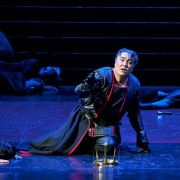
There is no place for religion here. The high priest Ramfis is a military leader, the ceremony in the Temple of Ptah becoming an initiation ritual around an oil drum, smearing Radamès face with warpaint, the ballet playing as the soldiers’ drill.
A soundtrack of gunfire, bombs and sirens engulfs the audience before Act 2 – unnecessarily so, since it’s clear from the action on stage that battle has taken place. Radamès returns from war, eschewing acclaim, clearly suffering from post-traumatic stress disorder. During the Triumphal Scene’s Grand March – that most famous snippet of Verdi’s score, replete with six magnificent Egyptian trumpets played from the balcony – whenever the press photographer takes a shot, strange ambient whining is heard, as if we are inside Radamès’ head.

The ballet is staged as a brutal flashback to what he’s experienced. In Naamat’s skilled hands, this is no glorification of war, but an examination into the effects of war. There are no victors.
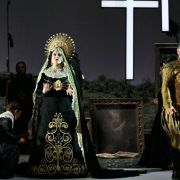
By Act 3, Amneris is in the same military uniform as Ramfis. Radamès’ trial becomes a kangaroo court torture scene – played out on stage rather than off – as Ramfis administers his brutal justice. By the final scene, Radamès has no need to be interred; he’s already dying, with Aida by his side. A repentant Amneris scrawls PACE on the wall as two children play in the rubble.

Musically, this opening night was a mixed success. I liked Monica Zanettin’s Aida immensely. Although she sings all the leading Verdi and Puccini roles, she seems more of a lyric soprano than a spinto and there were times where she was stretched by an unsympathetic Dan Ettinger in the pit, steamrollering his singers. She hurled herself at “Ritorna vincitor!”, displaying real artistry in the aria’s second half, where Aida lifts a prayer to the gods. She was helped by a swift tempo for “O patria mia”, conjuring up a childhood image, but nearly ran out of gas towards the end. In the closing “O terra addio” duet, she sang quite beautifully.


Giorgi Sturua was a solid Radamès, slightly constricted and with an ungainly end to “Celeste Aida”, but lasting the course and singing effectively when he turned the volume down. Volodymyr Tyshkov was a sturdy king, but local hero Tuomas Pursio’s wiry baritone lacked juice as Amonasro.
The two most successful singers were Don Lee’s gripping Ramfis, black in timbre, dramatically menacing, and Emilia Rukavina as Amneris. The Croatian mezzo has a ripe tone and a magnetic stage presence, visibly revelling in her taunting of Aida and railing wildly at the end of the Judgement Scene. After a performance like this, you can understand why Verdi nearly titled the opera Amneris.

Ettinger, making his Finnish National Opera debut, certainly drew an exciting performance. The splendid chorus and orchestra threw themselves into the bombastic ceremonial writing with relish – great to see a cimbasso in the pit for authenticity – and the shuddering double basses foreshadowing Amneris’ fury in Act 4 made the earth move. His swift tempi kept the action moving, but a little more consideration for his singers wouldn’t have gone amiss.
Mark's press trip was funded by Finnish National Opera