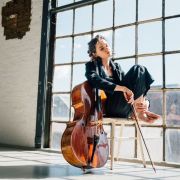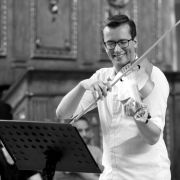


As anniversary celebrations go, Brooklyn Rider’s party in Prague with the music of Philip Glass was a subdued affair. To mark 20 years of playing the composer’s work, the group has been performing all nine of his string quartets, a program that normally stretches over three nights. A one-night version at the Prague Sounds festival offered six of the Glass quartets, played in a manner suggesting that there are more ways to approach his music than just the usual intensity.

The Riders took the stage casually, in clothing to match, and set themselves in a foursquare arrangement facing each other to accommodate an audience surrounding the stage on all sides. Their program opened with a muted treatment of String Quartet no. 7, dominated by the deep voice of the cello. The music stayed in that mode, creating a primordial soup of sound out of which thin, elegant violin lines seemed to rise like wisps of steam. String Quartet no. 2 followed, starting in much the same vein and only gradually taking on some of vibrancy typical of Glass’s work.


The performance moved into more familiar territory by concluding the first half with String Quartet no. 5, partly because of the piece itself, the most traditional of the quartets in structure and style. Strong opening tones set up a driving cello that gave the music momentum, a feeling embellished by blasts of what sounded very much like a train whistle throughout the second movement. The high strings contributed a steady rhythm that developed into a flowing melody before spinning up into ascending and descending runs that culminated in a dramatic finish.

The second half of the concert sounded more like vintage Glass, starting with Quartet Satz, a short work that was the first in the performance to offer a full soundscape. The rhythms cast their trademark hypnotic spell, the melodies unfurled in undulating waves and the playing had a soothing touch of tenderness. A fading finish left a sweet aftertaste.
There was a palpable sense of going on a journey with String Quartet no. 4, which opened large and bold, hit the hypnotic rhythms early and segued neatly into an ethereal second movement that featured haunting high string lines. There were moments that could have been a sci-fi soundtrack before the music turned melodic, setting up a somber final movement. The final piece, String Quartet no. 3, was a reprise from Brooklyn Rider’s very first public performance in 2005, and sounded like a happy indulgence, with riveting rhythms, delicate lines in the quiet passages and a gathering intensity. The music took on almost physical proportions, a full realization of its groundbreaking potential.


In some ways, the concert might have been more interesting if the quartets were performed in chronological order, tracing the composer’s development. But the program served as a retrospective for both Glass and Brooklyn Rider, and in that sense captured the spirit of adventuresome collaboration very well.
Finally, a word about the venue, a large shoebox space in an art gallery. The four blank walls were ideal for immersive abstract video projections, which for the most part added nothing to the music. Nor did that space help the sound, already muffled by the arrangement of the players. As an effort in innovative staging, it was laudable – but in service of the music, rather lacking. A more conventional presentation would likely have made for a better concert experience on both sides of the stage.