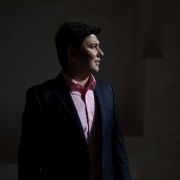
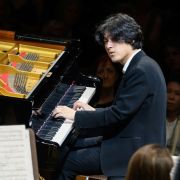
Theoretically, no one should be able to pull off a program of Prokofiev, Schumann and Scott Joplin. But Lukáš Vondráček is not your average pianist and in a rousing performance with conductor Elias Grandy and the Prague Radio Symphony Orchestra, he showed the impossible to be not just possible, but highly entertaining.

Vondráček was all business when he sat down to play Prokofiev’s Piano Concerto no. 3 in C major, coming in after an animated orchestral opening with a heavy hand in both volume and style. He matched Grandy’s enthusiastic spirit and then took it a step further, blazing through the insanely complicated runs with a fierce intensity. Hammering the keys and snapping off notes, he showed a virtuoso blend of technical command and torrid expression.


The second movement includes some relatively quiet solo passages that gave Vondráček an opportunity to lower the volume, though still with a firm touch. The orchestra came on strong with driving momentum, occasionally overwhelming the piano, with both surging to finish the movement in a wall of noise. The finale took off like a rocket and lived up to the composer’s description of the orchestra and piano ‘having an argument’, trading aggressive lines that ended in an explosive burst of energy with the pianist playing at a fever pitch.
In addition to being an uncommonly skilled player, Vondráček is a showman. He is given to body language like bouncing to the rhythms and an occasional leg kick, adding visual appeal to his performance. And he has a witty side, returning for an encore of Joplin’s The Entertainer – played in a classical style instead of ragtime rhythm, and at a tempo that sounded like an LP rotating at 78 rather than 33⅓ rpm. To show he can also be sensitive, Vondráček followed that with a second encore of the Träumerei from Schumann’s Kinderszenen that left the audience breathless. In all, an impressive outing that offered a heady mix of abandon and expertise.

The concert opened with a new piece commissioned by the orchestra from Petr Wajsar, a Prague composer whose oeuvre spans classical, pop, rock and film music. Cathedral is hard to describe, only because it changes so much. It’s not symphonic, or textural, or a tone poem, yet it contains elements of all those. The music comes and goes in fragments, simmers, drifts, swells to dramatic peaks and makes way occasionally for big blasts of brass. Grandy handled it with dexterity, segueing neatly between genres and crafting a fine finish of dancing flutes.


Strauss’ Also sprach Zarathustra put an exclamation point on what had already been a lively evening, with Grandy giving the familiar opening a fresh, crisp sound, then maintaining drama and power throughout the rest of the piece. Working without a score, he used teeming strings to build tension and lilting melodies to give the music a flow, and was not shy about using volume for impact. Overall, the conductor struck a fine balance between keeping the music agile while giving the piece body and depth – and a ton of expression.
Grandy is only in his second month as new Chief Conductor, but the orchestra seems to have already warmed to him. The sound was rich and full, which has not always been the case in the past, and the players seem finely attuned to his detailed direction. Add a hot-shot soloist to the mix, and it looks like a match made in musical heaven.