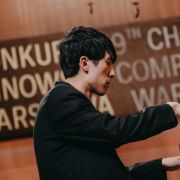
When a star performer strides across a stage with the demeanour of a man on a mission, those watching him mentally fasten their emotional seat belts, to be sure of not floating free from light-headedness. So it was with Evgeny Kissin. We knew he had with him a sonata of some substance, a selection of suave evocations of rustic dances, highly-charged etchings associated with an eccentric Kapellmeister who loved a good Burgundy, and a vividly illustrated plate from a famous collection of travel pictures. When the mission was accomplished, topped-off with three bonbons, the star drifted off into the night leaving a trail of… light-headedness.


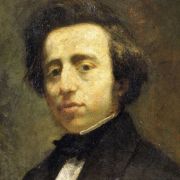
Lawrence Kramer wrote that “Beethoven can keep the cosmos; Chopin will always have Paris.” If there is anything cosmic about the former’s Piano Sonata no. 7 in D major, Op.10 no.3, it is that the composer was boldly exploring new expressive worlds with it, charged up with a boundless confidence. Kissin very persuasively glossed that adventure with a glitteringly articulated first movement, and a deeply sensuous second; the third surveyed an airy skittishness and the journey was completed with a self-referential swagger. Chopin in Paris was at ease with a selection of Mazurkas; a pair from Op.41, and one each from Opp.56, 63 and 68. As a subset of the programme they provided a space cleared for polished introspection and ruminative deliberation, with Kissin deftly side-stepping any sense of the faux sentimentality that is sometimes attached to these miniatures.
The Mazurkas represent one of the tonally variegated strands of the tentacled beast that was 19th-century nationalism; another is the Hungarian Rhapsodies of Liszt, a tentacle that in the past threatened to strangle the composer’s creative reputation. These days, the best of the set are welcomed guests in all the best places, hobnobbing with real A-Listers (pun intended). Kissin brought along the C sharp minor No.12, which he dispatched with a winning charm and a passionate demeanour. There was a brilliance to his playing where, especially in the upper reaches of the keyboard, the exquisite sound seemed not to result from the movement of his fingers but from some other-worldly source of animation. It was utterly beguiling.


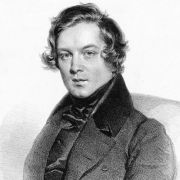
While the other items are works of high merit, the real masterpiece on the programme was Schumann’s Kreisleriana. The composer’s relentless outpouring of passion for his beloved Clara had in Kissin an interpreter fully attuned to its matchless expressivity, its self-propelling rhythmic and harmonic logic and a melodic skein that magically enfolds its innovative structure. Hoffmann’s eponymous Kapellmeister, had he been in the audience, would have hurried home and opened a bottle of his favourite tipple. Along the way he would also have savoured Kissin’s refined taste for sweetmeats: Chopin’s Étude in E flat minor; Larregla’s Viva Navarra!; and Tchaikovsky’s May from The Seasons. Only three encores: no one would have missed their last train.