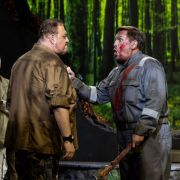
The overture’s echoing horn calls and bagpipe drone of oboes insist on the Alps. Nonetheless, the Boston Lyric Opera has set their rollicking frolic, La Fille du régiment, in 1775 Boston, under siege by British forces. Along with the 250th anniversary of Independence, the example of Plympton patriot Deborah Sampson, who successfully served nearly a year and a half in the Continental Army disguised as a man, sparked the idea for this inspired transposition.

Kirsten Greenridge’s new dialogue and director John de los Santos’s tweaks to Ruth and Thomas Martin’s standard English libretto further anchored the performance with local, period references which also extended to the music – Marie fires off an embellished snatch of Yankee Doodle to preface the regiment’s song. The Widow Birkenfeld even deploys local accents to great comic effect in her dialogue, all Brahmin refinement until provoked into full Good Will Hunting, non rhotic broad à mode in pronunciation and inflection. Two spoken roles are cut and the bass Hortensius became a soprano Hortensia.


De los Santos’s direction is inspired. During the overture, he stages a pantomime of Marie’s abandonment under the Liberty Tree. He further heightens the comedy by often synching action and coloratura as when Marie bobbles a bowl of hot soup, then frantically frisks herself for a spoon. A running gag involves what could best be called the Birkenfeld Swoop – right arm scything down as the Widow and Hortensia bent slightly at the hip at every mention of the name. The last mention triggers everyone on stage and in the pit to join in. He also transforms the Marie-Tonio-Sulpice trio in Act 2 into an antic game of musical chairs.

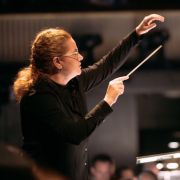
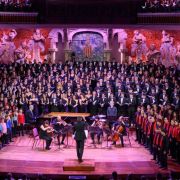
The BLO adopted their usual seating arrangement in the pit with the podium in the right corner. Kelly Kuo kept things percolating, tempi lively and alert with breathing space for quieter more intimate moments. Two of those belonged to Brenda Rae’s Marie. Very few singers can hold an audience in the palm of their hand the way she did with “Il faut partir” and “Par la rang”. Rapt attention is not something often associated with comic opera, but Rae achieved it twice and as artfully as she tossed off fioritura and enacted the knockabout comedy with coltish glee.

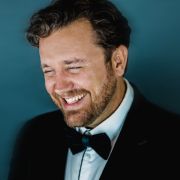
Spencer Britten sang with grace and ease but had the thankless task of affecting a stock French accent, bordering on Pepé Le Pew territory, when singing and speaking in English. Fortunately, “Ah mes amis” and “Pour mon âme” with its nine pinpoint high Cs (two performed with an acciaccatura) remained in French. Sandra Pique Eddy’s Widow and Angela Yam’s Hortensia had the comic timing of seasoned vaudevillians. Yam owned her scenes with a nasal delivery and quirky cadence in dialogue wed to a puttering wind-up doll demeanor. Whether individually or together, they raised the energy whenever they appeared and sang with verve and aplomb.


Kenneth Kellogg, a warm and avuncular Sulpice, exuberantly raced through his patter with crystal clear diction. Neal Ferreira’s battleship of a Duchess Crakenthorpe hove into view under full sail, thanks to Oana Botez’s voluminous costumes, and announced by Alfred Newman’s 1933 fanfare for the Twentieth Century studio logo. He sang “If you give me your attention” from Gilbert and Sullivan ‘s Princess Ida, whose plot turns on men disguising themselves as women, a sly tip off to the Duchess’ true identity as a male British spy (Gilbert’s “despicable man” was changed to “despicable cow”).
BLO likes to tinker with the operas it performs. Results have been uneven where serious operas are concerned. Maybe comedy lends itself more easily to transpositions than drama? Whatever the case, this production is an unalloyed success.