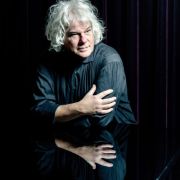
It was 1994 in Naples, when I heard Grigory Sokolov for the first time. He walked onto the stage, this large, unhurried man with slightly worn shoes and an air of complete indifference to the theatre of it all. He sat down, and performed Schubert's Sonata in A minor and Moments musicaux, before closing with a Kreisleriana that ranked among the finest I had ever heard. That evening, the piano became something else entirely. On Sunday, he presented a recital in the Concertgebouw's Main Hall.

To describe Sokolov’s expressive language is no simple task. Perhaps that is precisely what makes listening to him so fascinating. There was an iridescence to his sound, not the flat, even luminosity of the competition virtuoso, but something fractured and prismatic, like a ray of light passing through a lens and breaking into separate frequencies. Think of the defragmentation of a hard drive: a unit that reveals itself in its entirety only through the sum of minute fragments, each in its place, each carrying a precise meaning.


The programme was, at first glance, a journey through the heart of the classic Romantic repertoire. Looked at more carefully, something more: a meditation on form, on interior time. Sokolov's world was rendered with exquisite precision, every single cell of the score illuminated, weighed, returned with a clarity that had nothing cold about it; detail in the service of emotion, not the other way around. In this supreme unfolding, note after note, lay his complete identity as an artist.
The evening opened with Beethoven’s Piano Sonata no. 4 in E flat major, Op.7, a youthful work composed. Yet the Largo con gran espressione of the second movement already speaks a different language: Sokolov shaped it with a stillness that breathed, each phrase given its full weight before moving on, time suspended rather than merely marked. It was in these moments that one understood the difference between playing Beethoven and thinking from within him.
The Six Bagatelles, Op.126, were the other Beethoven, the Beethoven of total deafness and exclusive dialogue with silence. Brief in duration, immense in content. Each piece became a world unto itself, the fifth in G major floating with an almost improvisatory lightness, the sixth in E flat closing the cycle with a valedictory calm that Sokolov held to the very edge of silence. Those abrupt harmonic shifts that Beethoven scattered almost with malice were never smoothed over; if anything, their edges were sharpened, each one a small act of courage. To hear both works in the same evening meant traversing the entire arc of a genius, from the first bold stride to the final aphorism.


The second half belonged to Schubert, and with it the recital reached its emotional summit. The B flat major Sonata, D960, was Schubert's final piano work. It was music written by someone who knew, or sensed, that time was running out. There was no desperation, but something harder to bear: a serenity that knew its own cost, a peace earned at the edge of the abyss. The opening theme, serene on the surface, carries beneath it a low trill in the bass, a barely audible tremor that Sokolov, supreme master of ornamentation, kept alive like an underground current, never forcing it, letting it surface at its own pace. The Andante sostenuto that followed was a lament of almost unbearable beauty, the touch rarefied, the dynamics pressed to the threshold of the audible.
An unforgettable evening, just as it had been thirty years ago in Naples, when I ran backstage with the programme in my hands and the hope of an autograph.