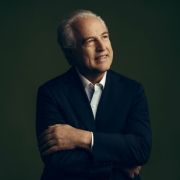
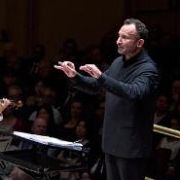
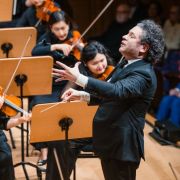
Manfred Honeck, a frequent guest conductor of the New York Philharmonic, came back for the first time this season to lead a starkly contrasting, supremely satisfying two-part program of Beethoven and Strauss. The evening opened with an impressive Philharmonic debut by the young Spanish violinist María Dueñas. Delivering a radiant rendition of Beethoven’s Violin Concerto – a work she performed with Honeck and the Vienna Symphony on a 2023 album – her elegant artistry and glowing tone were completely mesmerizing.

Played at a decidedly measured tempo, the opening of the Allegro first movement sounded especially gentle and serene, leading into a unique, completely captivating performance. A particularly lyrical Larghetto, dispatched with graceful tenderness and warmth, was followed by a genial, dancing finale. Dueñas’ virtuosity was most evident in the cadenzas – she played her own for all three movements – where she displayed total technical mastery, poetic sensitivity and a distinctive creative voice. In response to the audience’s enthusiastic ovation, she offered an encore: a poignant, highly refined rendition of Franz von Vecsey’s quintessentially romantic Valse triste.


The second half of the program was taken up by the Symphonic Rhapsody, Honeck's own arrangement of music from Richard Strauss’ 1909 opera, Elektra. One of six operas Strauss wrote in collaboration with Hugo von Hofmannsthal (who transformed his own 1903 German-language version of Sophocles’ drama into the libretto), the opera chronicles the Mycenaean princess’ quest for vengeance upon her mother, Klytämnestra, who together with her lover, Aegisth, murdered Elektra’s father, King Agamemnon, in his bath.
The Rhapsody, arranged in 2013-14 by Honeck in collaboration with composer Tomas Ille, is a viscerally vivid distillation of the original 100-minute score into a 35-minute tone poem. Premiered at a time when classical music was beginning to accept the atonal techniques espoused by modernist composers, the music shows Strauss at his most expressionistic – its harsh melodies and discordant harmonies reflecting the title character’s shattered psyche alternating with moments of touching lyricism.

Scored for a markedly large ensemble – including a huge percussion section and exceptionally heavy brass – the piece had a restless yet wonderfully cohesive flow as Honeck masterfully handled the many sudden shifts in tempo and volume. The Philharmonic’s bold brass were at their best as they thundered out the ominous notes of the “Agamemnon” motif, and the enlarged string section sounded appropriately warm and tender in the music from the scene where Elektra recognizes her long lost brother, Oreste. Altogether this was a truly memorable performance in which the orchestra successfully evoked all the psychological tension, terror and turmoil of Strauss' operatic masterwork.