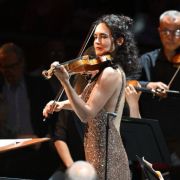
A very special programme marking the final concert as Wigmore Hall’s composer-in-residence Thomas Larcher featured a range of music that had a focus on Benjamin Britten and the viola playing of Timothy Ridout. The reduced Britten Sinfonia string section squeezed on to the stage, launching into a heartfelt rendition of the Cantus in Memoriam Benjamin Britten by Arvo Pärt. The smaller ensemble gave the intertwining descending scales an intensity and leanness that magnified the feeling of grieving. The tolling bell, placed in the balcony, gave a sense of space even in the intimate acoustic of the hall.


This tightness of sound and attack was carried over into an electric performance of John Adams’ Shaker Loops. This early masterpiece is one of the highlights of late 20th-century string orchestra repertoire. Adams’ take on minimalism is to strip the music down to the bare bones od rhythmic and textural variation. The Britten Sinfonia really seemed to revel in the intricacies and athletic challenges. The result was aptly a picture of joy, youth and energy.
The second half of the concert was conducted by Thomas Larcher with the focus on Ridout’s playing. Britten’s Lachrymae, in the late transcription for strings, is an important showpiece for the viola. It is a work I don’t particularly warm to it, however Ridout’s advocacy almost won me over. The fullness and beauty of his tone brought out all the mellow strengths of the instrument, and his refined sense of musical phrasing puts him in the top rank of performers on any instrument. The emergence of the Dowland theme in the final bars was exquisite played.


Larcher introduced his own work Still and told us it was his first commissioned work, also saying that coming back to it he thought he had achieved a rawness that he has struggled to repeat. Hearing the work after this speech one could see what he meant. There is a very sure-footed path and atmosphere in the work, which although at times is harsh and devilishly dark, is extremely direct in its utterance and exciting in its effect. Ridout was clearly fully committed to the concoction of long held notes over the deep sounds of the plucked strings of a piano or the double bases at their lowest notes, as well as the strings section scurrying and making percussive sounds. Ridout and the Britten Sinfonia were totally persuasive, a brilliant showcase for the soloist and satisfying for the audience.
Ridout’s first encore was the wildly challenging fourth movement from Paul Hindemith’s Solo Viola Sonata no. 2, which was not for the fainthearted.