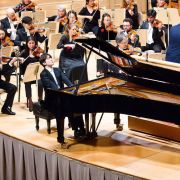
At a time when many piano recitals gravitate toward large-scale narratives, sonorous excess and overt displays of virtuosity, Leif Ove Andsnes chose a markedly different path at Carnegie Hall. Assembled from fragments, aphorisms and character pieces, his programme unfolded as a meditation on economy and focus: on how much can be said in a few bars, on the potential of silence and on the expressive assurance that emerges from intimacy fashioned with rigor.

The programme adopted a quasi-symmetrical structure, with two Schumann cycles bracketing two 20th-century sets, one early and one late. Schumann’s Klavierstücke and Carnaval revealed two sharply contrasting yet complementary facets of the composer’s pianistic imagination. The Klavierstücke, conceived largely as études and rarely performed as a complete set, project an introspective stance: compact, exploratory pieces in which counterpoint, voicing and texture take precedence over overt character. Andsnes shaped the opening numbers with pared-back clarity, allowing the more lyrical Romanze to unfold with poise. Carnaval, by contrast, turns decisively outward, offering a kaleidoscope of sharply etched personalities and musical ciphers. Volatility and reflection were balanced, from the assertive gestures of the Préambule and Valse noble to the hushed inwardness of Aveu, their contrasts absorbed into a broader continuity of tone and flexible pacing.


In the extracts from György Kurtág’s Játékok, the programme shifted toward a more distilled focus. These pieces, often little more than brief notations, depend less on development than on presence. Andsnes approached them without irony or sentimentality, giving each fragment its own space while resisting the temptation to connect them artificially. Attacks were clean, dynamics finely judged and caesuras allowed to register as structural elements in a yin-yang equilibrium of sound and silence. Any sense of searching for progression in listening gave way to attention to touch, weight and the decay of sound. Andsnes presented Játékok not as pedagogical material, rooted in the teaching studio, but as music of genuine consequence, its austerity functioning as a frame, not a limitation.
Heard without pause, the recital’s first-half progression from Schumann through Kurtág to Janáček didn’t align sonorities so much as the way musical ideas were set into motion and brought to rest. In Schumann’s Romanze, Andsnes softened points of arrival so that phrases seemed to withdraw mid-thought, their lyricism ending in ellipsis, not closure. Kurtág’s Les Adieux distilled that impulse further, reducing it to a bare act of leave-taking, the music relinquishing its momentum just short of arrival. With its explicit reference to Janáček in the subtitle, Les Adieux also prepared the ground for the first book of On the Overgrown Path, where endings no longer recede or suspend but seem to answer something unheard, nonexistent, yet vividly imagined.
Janáček’s short pieces draw their intensity from memory, speech rhythm, and folk inflection. Andsnes guided the cycle with a supple sense of timing, letting individual numbers appear as transient states instead of sealed narratives. In pieces such as Come with Us! and Our Evenings, his understated phrasing and gently suspended pacing brought a poetic inwardness to the surface. Heard through the sensibility of the Norwegian pianist, these moments carried the faint perfume of Grieg’s Lyric Pieces. Darker numbers such as The Barn Owl Has Not Flown Away! unfolded with taut, nocturnal unease, their nervous figurations and abrupt harmonic turns refusing to settle. Throughout, the pianist favoured suggestion over declaration, allowing Janáček’s fragile emotional world to register with charm but without strain.


Andsnes is an artist for whom proportion and control are central. In an evening that included two encores, Chopin’s Tarantelle and Mozart’s Rondo, K.485, reduced scale and completeness of meaning proved fully compatible.