With no rain, much less snow to be found on an unseasonably warm December night, Los Angeles made do with vicarious Winter Daydreams, courtesy of Tchaikovsky. Three symphonies he composed, so wags used to say – the Fourth, Fifth, and Sixth. But his earlier symphonies are no less inventive.

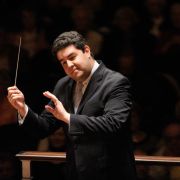
Guest conductor Thomas Wilkins realized Tchaikovsky’s youthful First Symphony in affectingly balletic fashion. Fitting for the future composer of Swan Lake and The Nutcracker, whose roots could be traced back to this work, particularly its Scherzo’s graceful, waltzing Trio, which Wilkins directed into a splendid pas de deux. But the conductor also kept his audience attuned to the many Tchaikovskian instrumental felicities in this symphony – those characteristic arabesques for woodwinds, moody horns and fluttering strings. Wilkins kept Tchaikovsky neatly groomed and light on his feet, as well as forward looking. Weber and Berlioz can be discerned in Tchaikovsky’s First, sure, but Wilkins also emphasized the work’s distinctiveness and confidence. Not bad for a composer still in his twenties.


In our time, Carlos Simon is another composer whose music is energized by eclecticism. Occupying residencies at the Boston Symphony and Kennedy Center, he has been composing a body of work that is rapidly earning attention. Gospel and vernacular idioms have left deep imprints on his orchestral work, similar to how the theatre shaped Tchaikovsky’s.
Simon has also distinguished himself by his responsiveness to topical issues, but his music, including his Four Black American Dances from 2022, thrives without support from extramusical devices. Applause and brass jeers that sound like something out of a rowdy night at the Apollo Theatre punctuate the galvanic first dance. A hazy waltz, an evocation of the debutante balls held by affluent African Americans of the early 20th century, follows, with tipsy polyrhythms pushed along by harp licks. Tap dancing and Sunday church services, complete with glossolalia, were the foundations of the final two movements, which concluded the work in a fittingly joyous mood. Balancing irony and sincerity, menace and amiability, Simon’s dances are a compelling and unsettlingly Brittenesque statement.
Duke Ellington and Billy Strayhorn’s post-big band take on Tchaikovsky’s Nutcracker Suite, on the other hand, is something altogether more forthright, both in sonority and character. Tchaikovsky, in their treatment, is removed from his pedestal to be embraced by the people, and fitted in a natty houndstooth suit and a pair of Florsheim Imperials. Jeff Tyzik’s adaptation for symphony orchestra is subtle, taking advantage of expanded instrumental colors while remaining true to Ellington and Strayhorn’s original.


Deceptively virtuosic as it is, the suite was most of all an attractive showpiece for the versatility of the Los Angeles Philharmonic. They were really swinging on the Disney Hall stage, with woodwind and brass sounding especially ecstatic. They were disciplined, too, with elastic rhythms that never turned messy and ensemble attacks that were always razor-sharp.
Percy Grainger once called Ellington one of the three greatest of all composers. Wilkins and the Los Angeles Philharmonic made a very persuasive case for that boast.