Composer Missy Mazzoli and her librettist Royce Vavrek have both lost family and friends to opioid addiction, a crisis touching many people and costing hundreds of thousands of lives. OxyContin, a slow-release prescription painkiller marketed as safe and with low addiction risk was made by Purdue Pharma, a company owned by the Sackler family. Ironically, several opera houses received Sackler donations (including in Scotland), which has led to hasty renaming and a difficult legacy of higher scrutiny of artistic philanthropy.

Massoli and Vavrek have been seeking a way to explore the subject, working with writer Karen Russell, who devised an allegorical tale inspired by Franz Kafka’s surreal story A Country Doctor. What better medium than opera to explore greed, grief, love and the nightmarish dreams of opioid addiction, especially adding in the excitement and thrill of galloping horses? The Galloping Cure was the result, and an eye-catching world premiere for the Edinburgh International Festival arrived complete with the composer’s advice to buckle up for the ride!


Taking place over a year, the town’s doctor Theresa Hart does her best for the community, but many are sick and she is herself plagued by migraines. Her teenage daughter Noy challenges the ‘doctor is always right’ principle, but then Lucky Mack arrives in town with an enchanted carousel of horses. Riding them makes everyone forget their pains, the first ride free. The townspeople are allured, including the elderly and much-pained Ivona Kowalski. Demand for the horses spirals and Mack limits the rides to twice a week and, in a mischievous touch, introduces dynamic pricing. Home horses become available, tempting the Doctor for a while who sees an end to her migraines. The town is in a downward spiral and broke from paying Mack his dues. The tale turns ghoulish as donating body parts to keep the horses fully serviceable becomes a final option. The Doctor manages to pull back from the hysteria, but is unable to save her daughter, with Mack reminding her that she is a complicit partner in his schemes. But then there is her granddaughter, baby Rosa.

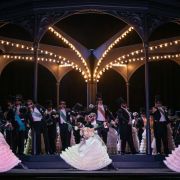
Scottish Opera and Opera Ventures Productions, with Tom Morris as director, have created a memorable show on a boxed skeletal grey wireframe townscape from designer Rebecca Ringst. Lucy Carter’s lighting is a feature of the production, descending vertical tubes of moving bright colours brilliantly depicting euphoria induced from riding the horses. The white horses are magical ‘steeds of sea-glass eye, their faces split open in a smile’, a joyous theatrical coup as they take to the air, rising and plunging amongst the pulsing light show.

Argentinian Daniela Mack headed the cast perfectly as the conflicted Doctor Hart, her rich mezzo totally embodying her role. She was by turns vulnerable, compassionate, hesitant to fully embrace the Galloping Cure, grief-stricken over her daughter and eventually fearless when confronting Lucky Mack. Mazzoli and Varvek have created a fascinating operatic character, the opera as much about her as the town’s hysteria. American-Canadian soprano Gabrielle Turgeon as Noy was one of the opera’s wild teen pack, remonstrating with her mother and luminous when her life falls apart. Justin Austin’s slippery-smooth baritone commanded the stage as the dangerous Lucky Mack, pushing his magic horses relentlessly. Susan Bullock gave an endearing performance as the elderly Ivona, gamely riding high but then out of funds; in a particularly gruesome scene, donating her eyes, knees and tongue for the cause. “We are running short of eyes,” says Mack.


Scottish Opera nurtures and develops Emerging Artists, and it was wonderful to see these young singers taking the minor named parts on this international stage. Most were troublesome teens, but we also had a chorus of sheep and two memorable talking dogs from Catriona Hewitson and Edward Jowle who all provided some much-welcome amusement, supertitle fun, but also commentary on the failing human world around them, all finely sung. Costumes from Christina Cunningham were all urban youth, with Lucky Mack the sharpest dresser. Leah Hausman’s fluid movement direction provided infectious energy throughout.
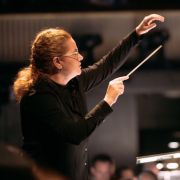
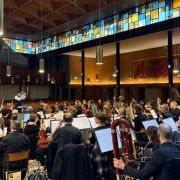
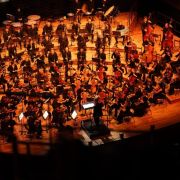
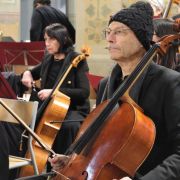
Stuart Stratford conducted Scottish Opera’s Orchestra who were on blistering form, the players embracing Mazzoli’s full, dense, restless episodic score with real verve and thunderous brass playing. For the euphoric events, a rave beat soundtrack by Blume and Lorna Dune mixed in perfectly with the orchestra, Stratford donning a headset to keep things together.

Despite a few longueurs, The Galloping Cure works particularly well as a fable, capturing the physical excitement of being on a galloping horse, but in a carousel, simply going round and round and getting nowhere, every dismount an increasing disappointment. It’s heading off to its co-producing houses in Sweden, Canada, America and Australia. It is well worth catching.