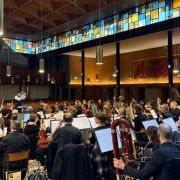
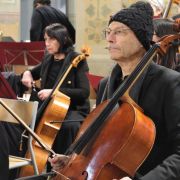
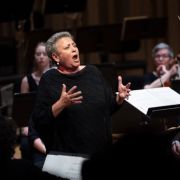
Paris is home to around ten amateur orchestras – and more if we include chamber ensembles, groups that come together for a single programme, and small brass bands. In a series of three articles, we set out to explore these orchestras, from rehearsals to concerts, to gain a better understanding of what drives them and what they reveal about our collective relationship with music. Following the first instalment devoted to Ut Cinquième, this second part turns to the ensemble Elektra.

Amateur orchestras sometimes play in the big leagues: with Elektra, performing Holst’s The Planets this weekend in the Pierre Boulez Hall at the Philharmonie de Paris, we’re on a whole new scale. For Kervin, tuba player and hairdresser, this is more than just a personal achievement: “I arrived from Venezuela without speaking a word of French five years ago, and today I’m on stage at the Philharmonie – it’s proof that anything is possible.” For him, the orchestra is a means of integration: “It was the tuba that allowed me to meet people. Here, I was welcomed from day one: ‘He plays well, he doesn’t speak – never mind.’” He practises his scores every lunchtime during his break, in the basement of his hairdressing salon, while the customers wait upstairs.


A few metres away, someone points out a trumpeter: “Can you see that one? I can assure you he’s played more great trumpet solos than a great many professionals!” We approach the man, a computer scientist named Julien, who has probably played in every amateur orchestra in Paris, sometimes almost simultaneously: “For a long time, I rehearsed every evening and gave concerts every weekend,” he admits. I’d get home at midnight just to sleep, and start all over again the next day. But I’m getting older, so I’ve had to take things a bit more slowly.”
When asked what it means to him to play at the Philharmonie, Julien pauses, searching for the right words: “It’s a dream, it’s incredible.” Then he describes the end of Neptune, the final movement of The Planets, where the women’s choir fades away pianissimo into absolute silence: “During the final moments of the transition, the tears came. I don’t know if I’ll ever have the chance to play in the Pierre Boulez Grand Hall again. It’s an unimaginable opportunity for a small time musician like me from the north of France.”

Claire, a violist with Elektra, is a paediatrician. She works in a home-care service for sick children, and juggles her on-call duties and her schedule as a single mother of three around the Tuesday evening rehearsals. “I come to make music. I come no matter what, whatever the programme. I need it; it carries me through the tough times. Even when I’m exhausted, I come.” When you spend your days alongside children on the brink of the abyss, it’s probably a vital need to lose yourself in the theme of Jupiter, the most beautiful in the world.
But Claire very nearly never got to this point. When she had reached a certain level at the conservatoire, having no ambition to turn professional, the director told her she had to stop her lessons: priority was given to future pros. Looking back, she puts it this way: “How can we hope that classical music will survive without very good amateurs? We’re the ones who consume music. I pay for my children’s lessons, concerts and sheet music. I think I consume more music than my brothers and sisters.” Her brothers and sisters, however, carried on unhindered – her brother is now a violinist with the Orchestre de Paris, her sister a cellist with the Paris Mozart Orchestra. Since that concert with Elektra, as it happens, Claire and her sister have had an unexpected thing in common: both were conducted by Lamar Elias, the assistant conductor for that Elektra performance. “It was fun to have that in common, in our completely different lives.”


Lamar Elias is a young Palestinian conductor about whom all the musicians speak with equal admiration. “She’s magical,” says Claire. “There’s something special about her, something unconventional.” She won the Musicians’ Prize at the La Maestra international competition, organised by the Philharmonie de Paris and the Paris Mozart Orchestra. As a conductor at the start of her career, it’s essential to clock up the hours. Lamar Elias puts it bluntly: “A professional orchestra isn’t a laboratory. It may excuse a few mistakes by the conductor, but its tolerance has its limits. An orchestra like Elektra is a wonderful laboratory, because anything is possible – or almost anything.” She talks about time management in rehearsals and the need to make mistakes in order to learn not to make them again: “You can’t stand in front of a professional orchestra and mismanage your time; it’s unthinkable to make that kind of mistake. And that’s something you learn through rehearsing.”
For a more experienced conductor, the challenge is different: the chance to gain a complete grasp of a work. Léo Warynski, a conductor who has worked with Ut Cinquième for several seasons, explains that “the sound is in your hands.” You cannot become a conductor without having hours of orchestral experience in your body, in your arms, in your palms. Warynski illustrates this point with an analogy: “Imagine you’re a pianist and you’re learning all your pieces using a piano drawn on a table. You press the keys, but no sound comes out. It’s a bit like that with an orchestra. A conductor might have all the best ideas in the world and conduct at home in front of an empty space, thinking his gestures are worthy of Karajan and Bernstein. But until it has been tested in front of an orchestra, it is worthless.” For Warynski, the only difference between an amateur orchestra and a professional one is adaptability: “If a beat pattern is complex, an amateur orchestra will need you to explain it to them, whereas professionals will understand it immediately.”

At the Philharmonie, Elektra showcases the most spectacular side of the amateur world: large ensembles, large scale repertoire and a great concert hall. It remains to be seen, in the third instalment of our series, how these ventures can be sustained over the long term, when they rely on volunteers and have venues to be secured and budgets to be maintained.
Translated from French by David Karlin