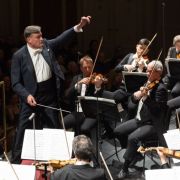
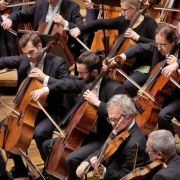
This programme unexpectedly created headlines when a disagreement regarding the seating plan for Mahler’s Fifth Symphony led to Iván Fischer withdrawing a week before the first performance. His replacement was Andrés Orozco-Estrada, apparently willing to accommodate the Berliner Philharmoniker’s standard arrangement: first and second violins to the left; cellos, violas and basses to the right. Indeed, the Colombian conductor, who recently took over the reins at Cologne’s Gürzenich-Orchester – the very band to have premiered the symphony in 1904 – radiated an easy-going bonhomie throughout.

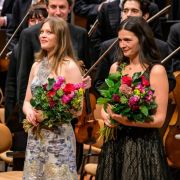
And that is exactly what one wants for Haydn’s irresistible Sinfonia Concertante. Here Orozco-Estrada captured all the music’s sunny good spirits, happy to take the lead from the four soloists drawn from the orchestra: Noah Bendix-Balgley (violin), Bruno Delepelaire (cello), Jonathan Kelly (oboe) and Stefan Schweigert (bassoon).


It was a shame, perhaps, that the combination of Haydn’s chosen solo instruments and the available principals apparently necessitated an all-male line-up, but there was no gainsaying the quality on display. Bendix-Balgley and Delepelaire sang their often high-lying lines with impeccable sweetness; Kelly and Schweigert proved the most eloquent and garrulous conversation partners. Their virtuosity and the responsiveness of their colleagues in the orchestra were a given. This was a superb performance.

All four soloists returned to take their places in the expanded orchestra after the interval for the main event: a performance of the Mahler in which a smiling Orozco-Estrada visibly revelled in the orchestra’s bright brilliance. He launched the opening Funeral March with purpose and a refreshing clarity of vision; there was an almost Classical approach in which this melancholy procession was always kept moving. The second movement was unleashed with powerful vehemence, the contrasting lyrical sections beautifully shaped. The grand climax was reached with an impressive sense of inevitability.
Where, though, I began to wonder, were the doubt, the angst, the darkness? The clarity of Orozco-Estrada’s vision, the wholesome sense of purpose he imposed, controlled rubato apparently born of certainty rather than betraying a stuttering neurosis: it all underplayed the work’s nature as a battleground between tragedy and triumph. By the time of his Fifth, Mahler had shied away from assigning overt programmes to his music, but this performance seemed to swing too far into the “absolute”, to deny too much of the heart, soul and sorrow that the composer continued to pour into his work.


The same doubts persisted in the Scherzo. It was terrifically played, with powerful contributions from Principal Horn Stefan Dohr and an especially delicious lilt to the strings’ trio-like sections. But the brightness and confidence of it all risked turning it into a mere showpiece. The famous Adagietto, meanwhile, served up all the sweet nothings one could wish for, whispered as only this orchestra’s elite string group can, but left me strangely unmoved.
Without enough sense of the early movements’ struggles, the finale’s hard-won joy and triumph rang a little hollow. The players’ high-spirited virtuosity was thrilling, no doubt, and Orozco-Estrada drove them excitingly. At the end of it all, though, I felt I had only heard half the story.