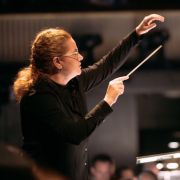
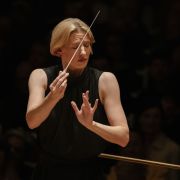
Relentlessness is the keyword of Aribert Reimann’s 1978 opera, Lear. Presented in a new, stripped-down staging by Barrie Kosky, this is Komische Oper Berlin’s third presentation of the work. The vocal writing is expressionist and anti-naturalistic, full of registral jumps, barked curses and commands. The orchestra accompanies with hoarse, barking fanfares, dense clusters and uneasily-swaying microtones. On top of this, a large percussion section unleashes a barrage of sound: thundering bongos, timpani, metal beaten and bowed. All this risks becoming muddy if the detail isn’t precisely rendered. Conductor Nicholas Carter navigated the Komische Oper Orchestra through the thicket with aplomb.

The cast managed Reimann’s difficult writing with admirable clarity, often while moving at speed across the stage. As Lear’s three daughters, Penny Sofranoiadou lent Cordelia austere lyricism, Rosie Aldridge gave Goneril a ferocious steeliness and Nicole Chevalier delivered the coloratura part of Regan as if possessed, each word jerked around in elaborate melisma. Ex-Tatort star Dagmar Manzel, a long-time Kosky collaborator, rendered the Sprechstimme of the Fool somewhere between a cynic’s Charlie Chaplin and Pierrot Lunaire.


Reimann wrote the central role at the urging of his long-time duo partner Dietrich Fischer-Dieskau, and it carries much of the opera’s weight. Both using and pushing against the baritone’s innate lyricism, the music explores those moments when song cracks round the edges, collapsing into hoarse speech and paralinguistic cries. Fischer-Dieskau himself leaned into the lyrical elements, humanising Lear. The lead here, Scott Hendricks, instead emphasised those elements where the part moves away from song, whether towards snarled orders or cries of despair.

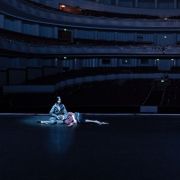
This approach fitted the production down to a tee. In Hangar 4 of the vast, Nazi-constructed Tempelhof Airport, a bare transverse stage is enclosed by audience, orchestra and a six-person percussion section in two purpose-built metal towers. The singers move around at speed, miked-up and followed by constantly-moving spotlights, plotting, scheming and cursing each other in barking parlando.
In the programme, Kosky suggests that this is an opera about patriarchy run amok. As in Karoline Gruber’s 2015 Staatsoper Hamburg staging, Lear is costumed as a contemporary businessman. As he strides across a giant dining table which detaches from the front of the stage, his entourage whoop and jeer as if at a men’s rights convention. His sterility curse on Goneril, delivered as a satirical cantilena, is truly stomach-churning. Rejected by his daughters and turned out onto the “blasted heath”, Lear strips to his underwear and disappears inside a cloud of dry ice and a massive hexachord. Reimann conceived the ensuing storm as the opera’s centrepiece, drawing inspiration from his experience of the bombing of Berlin as a child. It remains shattering in its impact (the timpanist wears ear protectors).

Following this, the music drops to a purgatorial stillness. A crowd of adults costumed in children’s pigtails, dungarees and dresses shuffle on and shuffle off. To a sombre bass flute solo based around a tone row, Edgar rises from under the stage, disguising himself as “poor Tom” in a sequined cap, grubby miniskirt and ballet flats. His voice shifting from tenor to countertenor, Aryeh Nussbaum Cohen’s keening delivery of the vocal line was supplemented by bowed tam-tam and cymbals, contrabassoon growls and high winds, in some of the opera’s most compelling music.


Kosky suggests that Edgar offers a queer alternative to Lear’s self-destructive patriarchy. But Edgar’s yearning music offers only a glimmer of hope. After an interlude in which Manzel recites Shakespeare’s Sonnet 66, Gloucester’s blinding is staged for maximum grand guignol effect. Cackling manically, Regan tears out an eye and eats it, in an apparent echo of Nicolas Winding Refn’s garish fashion industry satire The Neon Demon. “Blood flowing fast” sings one character before being shot... and it certainly does.

Wearing a military greatcoat, Cordelia sings tenderly to an exhausted Lear from the other side of the stage, her music an inversion of Edgar’s tone row. Microtonal strings slide towards whole-tone reconciliation. Beginning to recognise his daughter, Lear imitates her melodic lines. The parent learns – too late – from the child.
But the stage is invaded by soldiers in combat fatigues and we move relentlessly towards a bloody dénouement. Gunshots boom, percussion thunders and bodies litter the stage. Curtains, revealed as giant black inflatables, collapse from the hangar windows. Lear laments melismatically over Cordelia’s corpse, her leitmotif dissolving into orchestral microtones. Finally quiet, the music dies with Lear. The applause was thunderous.

“Forces are suddenly released you never even knew existed,” Reimann remarked of his experience of wartime bombardment. Lear, perhaps, still has something to tell us about this kind of haunting. For if there’s one thing we’ve learned of late, it’s this: as Edgar puts it, “the worst is not / So long as we can say ‘this is the worst’”.