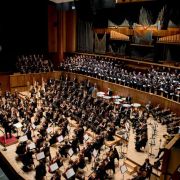
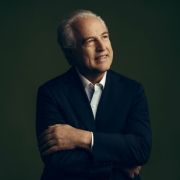
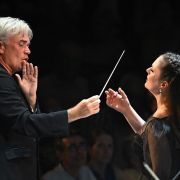
A rare appearance in the UK by Sir Donald Runnicles, a longtime fixture of the German classical music scene, had prompted excitement among audiences in London. The proposition of hearing him conduct the Philharmonia in Bruckner’s Symphony no. 8 in C minor stirred the musical loins of Bruckner-lovers, and there was a palpable buzz at the Royal Festival Hall on the evening. Alas, Sir Donald was indisposed, but Lawrence Renes gamely stepped in at short notice to lead the orchestra in the Haas edition of the score.


There was no musical amuse-bouche; the evening was solely dedicated to this last of Bruckner’s completed symphonies. Renes’ interpretation eschewed the ponderous approach championed by Sergiu Celibidache and others, nor was it leaden or pompous. There was instead a certain lightness that Renes brought throughout the symphony, perhaps less so in the first movement, where the Philharmonia sounded slightly less confident, the interpretation a touch disconnected. Even here though, the Philharmonia sounded splendid; the woodwinds ethereal, delicate and yet solid, with some particularly fine clarinet playing. Pizzicatos were plush and, in the early piano moments, there was a focus and clarity that demanded the audience’s attention. Renes built up to the glorious first movement climax with care, the first desks smoothly seething, lending an inevitably to the brass flurries, in total harmony of attack; the climax was mounted and abated gently away. The second movement saw the strings bristling and whirling against joyous, vibrant brass, the flutes limpid against the harps.


The third movement saw Renes at his best, bringing a sinuous unity to the orchestra, with ebb and flow between the first and second desks. There was a brightness to the sound, a glow that shone from violins to brass. Pacing was tight, the playing forward-looking and deft, a real pleasure to hear. And then the fourth movement: Renes’ tempi were again energetic, yet not brisk, with a clarity of attack from the strings and rounded blasts from the brass. The finale to the fourth movement, like that of the first, was built and mounted with care, all sections of the orchestra audible.
Renes had the Philharmonia playing at full throttle and allowed the players to demonstrate their facility for this kind of repertoire – on this basis, a plea to those that make such decisions not to preface future concerts with the kind of speech that one of its player was obliged to give (at least five minutes of cliché). The Philharmonia deserves better than that.