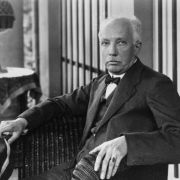
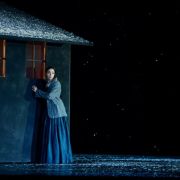
Strauss’ Der Rosenkavalier is set in 18th-century Vienna, era of the greatest Kaiserin, the Empress Maria Theresa, whose name is significantly shared with the Marschallin, leading lady of an opera where the libretto often references social rank. Even the boorish Baron Ochs describes his libidinous behaviour as merely a nobleman’s prerogative. Bruno Ravella’s 2021 production for Garsington Opera, here in its first revival at its original location, equivocates about the setting. In Act 1, the Marschallin’s bedroom has a large four-poster bed, but her stylish all-yellow outfit evokes a later period. Octavian wears a sword as the libretto requires, but later a contemporary looking policeman waves a handgun.

The blue-grey bedroom of that first act has a large leaf motif surface moulding, and for Act 2, the same setting is doubled in depth, and adds four chandeliers. Act 3’s “room in an inn” is a domestic and demotic space, with one wallpapered panel that slides away to reveal a bedroom, lurid with red light. Fine for the busy goings-on at the start of the act, if less suitable for the closing trio – sublimity encased in frivolity. The sets are surrounded by a neon-lit border, as is the smaller Act 3 room itself, offset at an angle to the stage-wide main set. That inner border flickered for a while, as if a bulb could blow, but stabilised realising it had important events to illumine. Overall Gary McCann’s designs serve this complex work well, as does the lighting of them by Malcolm Rippeth.


Ravella has returned to his production, launched in the Covid era, and explains in the programme that the social distancing required in 2021 has often been retained, for the tension it created and the sense of class – the distancing required by rank rather than risk of infection. The sheer wordiness of Hugo von Hofmannsthal’s brilliant text is a challenge for performers as it was for Strauss, but a joy when reading surtitles, if they retain not just plot development, but something of the librettist’s wit and style, as Jonathan Burton does here. The Austrian modernist Hofmannsthal was like WH Auden, a great writer whose voluminous output happens to include opera libretti.

The music was in capable hands. Three soprano leads are specified by Strauss, (who was passionate about the soprano voice), not least for the soaring lines of the final trio. And since he specifies mezzo-sopranos for some other Rosenkavalier roles, he knows the difference. But it is still common, as here, for a mezzo to sing Octavian, perhaps because the timbre will better suit that travesti role. Certainly Niamh O’Sullivan was superb in the part, one of several house debutants, and the pick of a good team of singers. But then the Marschallin, soprano Matilda Sterby, was no less accomplished in her very well sung assumption of the richest female part in all opera (well, perhaps, since Mozart’s Countess in Le nozze di Figaro, the probable model for the part). Soraya Mafi’s Sophie was not quite of this calibre, and although her sweet and light soprano is suitable for the role, in “Wie himmlische”, her reaction to the silver rose, she managed that taxing leap with accuracy, but little rapture. She was though, excellent in her frequent interactions with Octavian and others. All three sang with unblemished beauty in their transcendent final trio, the finest ensemble in all opera. (Again, no need for Mozartians to write in).


Ochs too, house debutant Andreas Bauer Kanabas, sang magnificently, using his sonorous bass with fine control, and with the histrionic skill to show Och’s pretension and self-importance without bluster. All the supporting roles were well cast, and as the Act One Italian Tenor, Russian-Ukrainian Egor Zhuravskii, a 2022 graduate of the Royal Opera’s Jette Parker Young artist programme, showed great potential on his house debut. This was a bit of luxury casting for Garsington, presenting a tenor now singing Tamino and Don Ottavio for this tiny part.

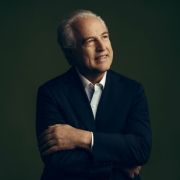
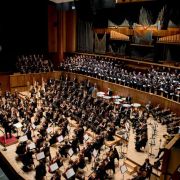
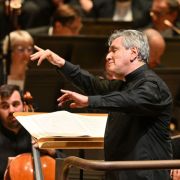
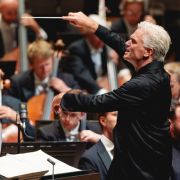
The only disappointment was the use of Eberhard Kloke’s reduced orchestra version. Not that that is not a skilful piece of work, but when you have Strauss specifying sixteen first violins and sixteen seconds, the use of six firsts and six seconds is a reduction not just in sound but at times in dramatic experience. Even the mighty Philharmonia Orchestra could not help but sound rather apologetic in Strauss’s climaxes, for all the dedication showed by conductor Finnegan Downie Dear in his first crack at this demanding opera, and that on his house debut. But he will be back we hope; after all he led an occasion when we got close to that rare thing, experiencing the full multi-faceted glory of Strauss and Hofmannsthal’s Der Rosenkavalier.