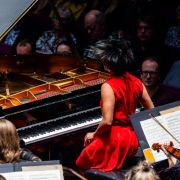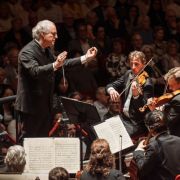


Collaboration is society’s latest trend and it seems none, even the hallowed world of classical piano music, is immune. This season’s latest partnership sees two very different pianists Evgeny Kissin and Sir András Schiff join forces, and what a treat they have in store. Sunday’s stop-off in Amsterdam, as part of the Concertgebouw’s ‘Great Pianists’ series, found two pianos standing side by side in the middle of the stage. With the lights turned low, it felt remarkably intimate; like peering into a bygone era, one with the household piano as the focal point of an evening’s entertainment. Their mix of music for two pianos and piano duet, the perfect antidote to modern, screen-based living.


Mozart’s Sonata in D major, K448, was the absolute highlight, full of cheeky antiphonal fragments passing seamlessly between the two. Just as their descent of the Concertgebouw stairs had illustrated moments earlier, walking side by side, this was a partnership of equals. They breathed as one, they played as one. Their nuanced phrasing – especially phrase ends – became a masterclass in galant elegance. Kissin swayed from side to side; Schiff, the rock, centred and refined, indulged in the Steinway’s rich, lower register. Their two perfectly choreographed page turners adding to the drama. Kissin’s lyrical Andante melodic line made way for moments of peace and solitude before an upbeat Molto allegro set off apace. Their phenomenal ensemble, particularly in the theme’s octaves repeat, was staggering.
Quickly changing pianos and swapping stools gave moments of light relief, but not for long. Despite Schumann’s comments about feeling rather melancholic when he wrote his Andante and variations, the pair allowed the composer’s wistful melodies to blossom and find a certain happiness. Kissin’s assertive and rising bass line offered direction to Schiff’s oft reflective and whimsical line. Emphatic dotted rhythms though, summoned an unexpectedly sombre funereal march and melancholy reigned. Rich harmony full of yearning dissonance continued the theme in his Bilder aus Osten.


Smetana’s Vltava completely changed the mood. Gentle waters soon turned turbulent as delicate inner notes found a delicious calm. Kissin’s bell-like top notes glistened in the night sky while Schiff’s pulsating swells beneath provided that magical cushion. In the distance, brilliant colours sparkled in the river’s majestic hue until calmly coming to a halt. For a moment, time temporarily stood still.
Merriment abounded in a medley of Dvořák’s Slavonic Dances, fluctuating between rustic delight; forlorn, meandering strains; elaborate flourishes; and resonant inner pedals belying a magnetic vulnerability. The Kolo’s effervescent finale brimmed with crystal clarity. Three encores later, and the two magnificent Steinway pianos basked quietly in reflective glory.