“Come to Schober's today and I will play you a cycle of terrifying songs.” Franz Schubert wasn’t kidding. By the time he composed Winterreise, his song cycle set to Wilhelm Müller’s poems, Schubert was in a very dark place indeed, in the knowledge that, because of syphilis, his days were numbered. By the time the composer completed it, Müller was dead. Schubert would follow him a year later.

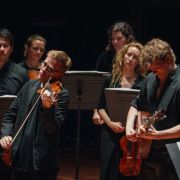
Unlike his other song cycle Die schöne Müllerin, which at least begins joyfully, Winterreise starts in resignation and just trudges deeper into despair, our jilted poet leaving town, journeying grief-stricken out into the cold. In his Wigmore Hall performance, Allan Clayton tapped into the bitterness viciously. After blanching his tone for the first two verses of Gute Nacht, vehemence took over, biting into the text.


I wonder how much Clayton’s interpretation has been influenced by his performances of Hans Zender’s “composed interpretation”, which he recently recorded with Aurora Orchestra and which moves Schubert closer to Berg. Gefror'ne Tränen (Frozen Tears) saw him deliberately veering off the note for sardonic effect, as if a tenor Wozzeck had wandered into Schubert’s parlour. Clayton’s near-Sprechstimme approach to Die Krähe (The Crow), treated like an hallucination, was haunting.
Consonants in Rückblick (Backwards Glance) were spat out, reaching a snarl in Mut! (Have Courage!). This was intensity dialled up to 11, although countered with rare softer moments, like the white-toned resignation in the penultimate song, Die Nebensonnen (The Companion Suns).
Leading Schubertian pianist Paul Lewis very much played the straight man, a sensitive foil to the hyper-dramatic Clayton. His piano accompaniments were considered and contained. Gentler moments like the rustling of the leaves in Der Lindenbaum or the galloping arrival of the post were neatly articulated. The discords of the hurdy-gurdy striking up in the final song struck an eerie note as Clayton, staring out into the hall, filled his final phrase with immense pain. I’m not convinced that everything worked, but at its best it was a reading that left an indelible mark, seared into the soul with a branding iron.


Wigmore Hall always programmes Schubert on his birthday (31st January) and Saturday also featured a rollicking lunchtime concert by The Erlkings. Devoted, as their name would suggest, to Schubert, the Austrian folk-rock band, fronted by American vocalist and guitarist Bryan Benner, sing Lieder in English, arranged for the unlikely combination of voice, guitar, cello, tuba – yes, tuba! – and percussion. Their transcriptions are done directly from Schubert’s piano scores, and even if they veer off into unexpected territory, the watchword over their material is sincerity.
Their set included two songs each from Winterreise and Die schöne Müllerin, a rippling Auf dem Wasser zu singen and an upbeat An Sylvia. Highlights were undoubtedly Erlkönig, castanets representing the horse’s hooves, and the anthemic climax to Gretchen am Spinnrade.
Benner’s intros were done with a smile and a wink – “If you want to know what happens at the end of Müllerin… well, it turns out he can’t swim!” – and they delighted the audience with their sheer exuberance. Heck, they even got the Wigmore Hall faithful yodelling along to Die Forelle!