As part of its centenary celebrations this season, the NHK Symphony Orchestra, Tokyo, has been exploring its history through works by Japanese composers who had strong relationships with the orchestra – a worthy project full of discoveries. In this concert, the second in this series, two Japanese compositions were featured alongside works by Sergei Prokofiev and Benjamin Britten who both visited Japan during their lifetimes: the former in 1918 and the latter in 1956 when he conducted the NHKSO.

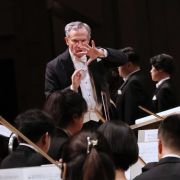
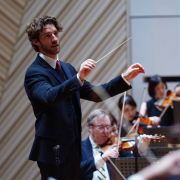
The evening opened with folksong-inspired Divertimento for Orchestra by Yuzo Toyama (1931-2023). Many Japanese will know Toyama as a respected conductor who was active right up until his death a few years ago, but he originally studied composition (as did many conductors of his generation). Premiered by the NHKSO in 1961, the three-movement Divertimento (a follow-up to his popular Rhapsody for Orchestra) is an orchestral medley of Japanese folksongs including Kiso-bushi from Nagano and Aizu Bandaisan from Fukushima. The folksong melodies, plangently sung by solo instruments such as the flute or oboe, are subsequently developed orchestrally. Conductor Tatsuya Shimono gave expressive freedom to the solo players while whipping up lively, festive fun in the tutti sections, vividly conjuring up the landscapes of the various regions.


After this pleasant, if a little schmaltzy, opener came the main attraction of the evening. Pianist Kyohei Sorita, a household name in Japan since becoming a prizewinner in the 2021 International Chopin Competition, was the soloist in Prokofiev’s Third Piano Concerto. I hadn’t heard him live for a few years, but Prokofiev seems ideally suited to his formidable technique and dynamic personality. Technically it was faultless. It was speedy and fiery, and the passages were articulate and brilliant, although occasionally I missed the music’s sarcasm. In the middle movement he highlighted lyrical moments with charm and elegance. Throughout, Sorita made sure he was in sync with the orchestra and in that sense, it was a satisfying performance, if a little tame. Still, in the final three minutes of the last movement he notched it up a gear and went for broke, bringing the performance to a great climax. He gave a breezy encore of an Étude from Moszkowski’s Op.76.

The second half began with another Japanese work, Ballata sinfonica by Akira Ifukube (1914-2006), famed for his score for the 1954 Godzilla movie and experiencing a revival in recent years. This two-movement orchestral work stems from the 1943 and was performed many times during the war years. Typical features of Ifukube’s music, such as persistent ostinato, percussive sounds and multi-cultural melodies and rhythms, were evident in this work and were vividly brought to life by Shimono and the players. Curiously, one of the first movement’s themes was very similar to the opening clarinet theme in the Prokofiev’s concerto – surely not a coincidence.


This interesting programme – with many intertwining connections – concluded with Benjamin Britten’s Four Sea Interludes from Peter Grimes, composed around the same time as the Ifukube piece. It was a refined performance with attention to detail, conjuring up the scenes on the Suffolk coast with colourful and evocative playing from the whole orchestra, especially the winds, brass and percussion. In particular, the final Storm interlude built to a powerful and doomed climax.