Musical legends in Liverpool are, almost invariably, associated with popular culture. But there is one living legend who, in his mid 30s, is still making a considerable impact, all the more so this season as he is the Royal Liverpool Philharmonic's Artist in Residence. Clarinettist Mark Simpson won the BBC Young Musician of the Year competition aged 17, while still at school. By then, he was already an active and widely performed composer and went on to take the accolade of BBC Proms/Guardian Young Composer of the Year.

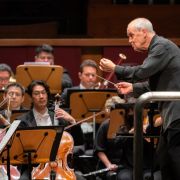
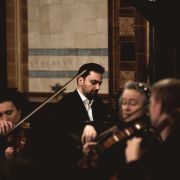
It was perhaps inevitable, then, that Simpson – back in his home city – should lead a 13-member wind ensemble plucked from RLPO. Billed as a programme featuring an “unstoppable blast of supercharged musical energy”, nobody could doubt that particular sales patter, evident from the very outset of the performance.


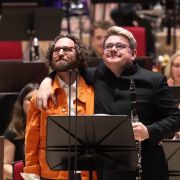
Simpson had billed one of his own pieces in the programme. Geysir was written in 2013 and is scored for all 13 members of the assembled ensemble plus double bass, the same line-up which would go on to perform an explosive interpretation of Mozart's Gran Partita. Geysir is a piece which combines thoughtful beauty with the odd eruption along the way. The piece bubbled with energy and closed with beautifully haunting oboe solos immediately before its sudden conclusion. Simpson did avert disaster, however, when his clarinet malfunctioned and he had to stop mid-performance, albeit it briefly. “Could anyone lend me a clarinet?” he asked, before retiring for some time, returning triumphantly, proclaiming, “Thank God for Super Glue!”
Simpson, playing basset clarinet this time, paired up with bassoonist Daniel Jemison for the UK premiere of Simon Holt's Amistad no 2. This was a series of short sketches, each complementing what had gone before but always bringing something new to the conversation. It was a bold dialogue between two players both pushing their instruments to extremes of their respective ranges and drawing on the respective virtuosity of both performers.
In lighter vein, Gary Carpenter's Pantomime for 13 Winds defused the emotion which had built in the first two pieces. Much of the music is derived from a score written for a production of Aladdin by Unicorn Children's Theatre in 1994. It is immensely approachable, combining themes which are instantly recognisable and influenced by jazz, music hall, Vaudeville, Burlesque with the odd quotation from TV music thrown in. The Prologue, for instance, melds together jazz with what could be described as generic film music. A wistfully beautiful bassoon solo in the Cavatina led to a vivacious Polka. But it was the Waltz-Finale, subtitled Depravity, which underlined the sense of fun which pervades the work.


The second part of the concert was devoted to a performance of Mozart's colossal Gran Partita. This was a real tour de force, pushing the musical skills of the performers to the limit. From the stately opening movement, through the humour of the minuets, the intense soul-searching in the Adagio – which was given a few moments' relief in the Andante section – through to the breathless, triumphant finale, this was first-class playing from an ensemble which never shied away from the challenge.