Brilliantly dramatic an opera as Puccini’s Tosca may be, it contains a lot of moving parts which need to work together to achieve its full impact. At yesterday’s Glyndebourne Festival opener, many – but not all – of the moving parts were in full working order, while others gummed up the works.

The evening’s best feature was the vocal performances of the our three leads, none of whom I have seen before (better still, arguably, was a particularly fine bit of singing from the Trinity Boys Choir and Glyndebourne Youth Chorus). Matteo Lippi’s Cavaradossi was warm, rounded, effortlessly delivered, easy-going in “Recondita armonia”, powerfully heroic under torture in Act 2, impassioned and moving in “E lucevan le stelle”. Caitlin Gotimer displayed a delightful timbre and felicitous phrasing; she brought the house down with the repeated “give her dark eyes” gag in Act 1 and then filled us with pathos in “Vissi d’arte”. On the scale of brute to snake, Vladislav Sulimsky’s Scarpia was definitely on the snake end, but vocally effective for all that: this is an elegant baritone voice that I’d be happy to listen to all night.


The trouble is, it only worked with your eyes shut, so lacking were the performances in any visible chemistry or antagonism between pairs of characters. You could hear the romance between Tosca and Cavaradossi in their voices, but you couldn’t see it in their body language. Tosca’s lapse from imperious to fearful and her desperate struggles to regain self-possession were unmatched by any outward physical evidence. And Scarpia’s demeanour failed to inspire proper visceral disgust or terror. Never have I seen such a mismatch between vocal excellence and ineffectual physical acting.
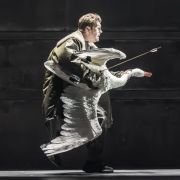
Director Ted Huffman’s staging choices are reasonable enough. He wisely opts for staying with the basic premise and dramatic flow of the original (in all honesty, it’s hard to do otherwise with Tosca). Nadja Sofie Eller’s sets and Astrid Klein’s costumes shift the action to fascist Italy, perhaps in the Second World War, and simplify down the original Napoleonic-era frippery, which works fine aesthetically.

Huffman adds some elements in each act, with varying success. The most successful is the transplantation of Act 3 from the Castel Sant’Angelo to what looks like a remote quarry, clearly a place of extra-judicial killing. I’m neutral as to the idea of Angelotti being accompanied into the church by a non-singing accomplice, whose main feature is that he is later brutally savaged by Scarpia’s goons. Where I part company with Huffman is in moving Act 2 and Scarpia’s “poor supper” from his very private chambers to a restaurant full of his supporters. I’m going to guess that the idea is to show the extent to which his brutality has become so normalised that the other diners barely notice, which sounds like a reasonable concept but which comes at a cost: for much of the act, I couldn’t stop my mind wandering away from the action to the question of whether Scarpia was going to succeed in clearing the room before being murdered. And that was a real shame, particularly In “Vissi d’arte”, when I should have been fully focused on Gotimer’s wonderful singing.


The climactic moments of Scarpia’s murder and its aftermath are understated to the point of banality: the ghost of Sarah Bernhardt, whose prowess in dumb-show inspired Puccini to create the orchestral interlude after the killing, will have been unimpressed by reducing the scene to Tosca dragging the body into the restaurant kitchen and then getting down on her knees to mop the floor.
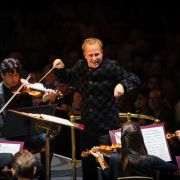
On the orchestral front, Robin Ticciati and London Philharmonic Orchestra were accurate, well paced and well balanced throughout, giving us plenty of space to enjoy the singing. But the Act 1 orchestral performance lacked the intensity which this opera can deliver. Perhaps everyone was just slow to warm up, because that intensity became more evident in Act 2 and even more so in Act 3.
In sum, while there was plenty to enjoy in this performance, given the importance of the occasion – Glyndebourne’s first ever staging of Tosca – and the reputation which Huffman brings to his first Glyndebourne production, I had hoped for considerably more.