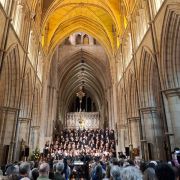
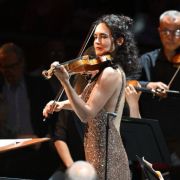
Unnatural Harmony: Sounds of Lee Alexander McQueen was a multimedia event that was a tribute to the life and creative vision of the iconic British fashion designer. Ambitious and crammed full of ideas, Robert Ames and John Gosling’s concept proved to have a bewildering sense of loss and pent-up energy. It was almost like opera reimagined for the 21st century, with music of different genres, singing, dancing, film and lighting aiming to coalesce into a meaningful whole. However, opera is a challenging art form which needs a strong central creative force to pull all the elements together and my only criticism here was that there didn’t appear to be any overarching direction from Elayce Ismail. That said, the journey was fascinating and powerful to experience in the moment.


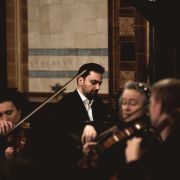
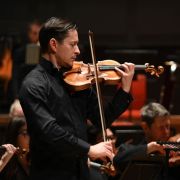
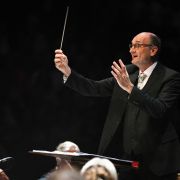
The stage opened in true operatic style to a touching rendition of Purcell’s Dido’s Lament by the drag queen Le Gateau Chocolat, in an outrageous green dress which had something of a duvet about it. This poignant moment encapsulated the tone of the whole evening. The London Contemporary Orchestra, keen throughout the evening, and conductor Robert Ames then took centre stage with film music by Philip Glass and Michael Nyman (from The Hours and The Piano respectively) which further emphasised the melancholy mood. We were then dragged kicking and screaming into the high energy sounds of Nirvana’s Smells like teen spirit. This juxtaposition of the melancholy and the manic in McQueen’s life was captured throughout the evening’s music.
Dancers Sari Mizo and Willow Kerensa Fenner occupied the stage for parts of the show, choreographed by Holly Blakey, giving physical form to a range of moods, notably serene in the Adagio from Mozart’s Piano Concerto no. 23 in A major and Penderecki’s searing Threnody for the victims of Hiroshima.

The film element of the show alternated with more dancing, this time Simon and Charlie Williams, who were choreographed by McQueen’s long-time collaborator, Michael Clark. The statuesque shapes created on a white background were visually stunning. It was as if the loss of his friend and creative partner was somehow frozen in time, still as raw as ever. Directed by Eddie Whelan and Douglas Hart, the films imaginatively caught the stillness and tension of the two dancers.


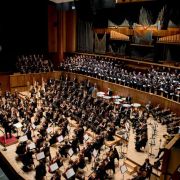
The LCO was notably in the spotlight (with electronic support) for Amand van Helden Dark Ages mix from The Witch Doctor, which blew the roof off the Royal Festival Hall and seemed to represent the dark hedonism of McQueen’s life. And as a polar opposite, a touching performance of Samuel Barber’s Adagio which, as ever, created a distinctive sense of loss. With Le Gateau Chocolat returning near the end for a knockout arrangement of Lady Gaga’s Bad Romance and the reprise of the sombre tones of Purcell’s lament, the abiding impression was that of a requiem, grieving for a man whose life was lived to the full, but tragically lost to us too early.
This review was amended to credit Robert Ames and John Gosling with the show's concept.