
Surely the least favoured of Puccini’s major operas in France, Manon Lescaut only entered the repertoire of the Paris Opéra in 1991. It seems that 33 years had passed since its last appearance in the French capital, so there was understandably much anticipation for this new production at the Théâtre des Champs-Élysées.

Three years ago Lorenzo Passerini conducted La bohème to moving effect at this venue, and he once again confirmed his affinity with Puccini’s music. With the Orchestre National de France and the excellent accentus chorus on impressive form, Passerini gave an exemplary interpretation of the score; while making the most of its brilliant orchestration, rich harmonic language and the composer’s infallible dramatic instincts, he never indulged in excesses of the kind that Puccini’s aesthetic can sometimes engender. In fact, it was the finesse of his conducting that proved especially memorable. Even at the most powerful – or indeed violent – moments, he maintained transparency in the orchestral textures, allowing myriad details of instrumentation to become evident, notably in Act 2, outstanding for the refinement of its coloration.
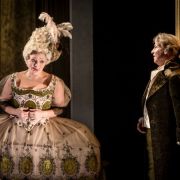
Oliver Mears’ production was given a cool reception by the audience and aroused mixed feelings. Its idea of Manon as an embodiment of the eternal feminine who traverses several centuries is nothing new, but it was well realised in this instance. More interesting was the way each man projected his particular fantasies on the heroine, to particular effect in the Act 2 dancing lesson, where Manon morphed from Salome to classical ballerina and then a sweet shepherdess from an 18th century pastorale.

Manon’s hair also became a symbol of her femininity and seductive power. Preceding each of the four acts was a dumbshow in which men took control of it in some way: at the start of the opera her father cut her locks brutally; Act 2 was introduced by a hairdressing scene; Manon’s head was shorn before her deportation in Act 3, and for Act 4 in America, a bunch of hicks crowned her with a blond wig.
It was the opera’s final episode that provoked the strongest reaction. Rather than dying in the desert, Manon ended up as a prostitute in a sordid bar, forced to dance and pick up tricks while Des Grieux, left alone on the stage, bemoaned his fate. While this relocation enabled the director to make his point about men as predators, it went against his intention (declared in his programme note) to avoid a sense of voyeurism around the heroine’s death. But most of all it reduced the tragic power of the last act of the opera, which is pervaded by a sense of solitude and exposure.That being said, Mears’ production was a real and highly coherent piece of theatre, not simply an assemblage of ideas, and the characters were astutely handled.

The cast was as satisfying as it was well-balanced. When it came to the supporting roles, Mathilde Ortscheidt’s brought notable refinement to her brief appearance as the Singer in Act 2, and Léo Vermot-Desroches (Edmondo, Dancing Master and Lamplighter) achieved extraordinary precision in his portrayal of tarnished, predatory masculinity, though he produced some uncharacteristically plummy sounds. A late replacement for the indisposed Lionel Lhote, Iurii Samoilov enjoyed a deserved success as Lescaut, convincing and assured in both vocal and dramatic terms.
More than 40 years into his career, there is still an astonishing freshness to Roberto Alagna’s timbre – his voice retains the ease of production and sunny glow that have been a defining force in his interpretations. Des Grieux is a demanding role and, understandably, he betrayed a hint of tiredness in the final act of the opera. It was a shame that, at the end of Act 3, he could not resist adding an unwritten top note – a showy and redundant gesture worthy of Mario Del Monaco in the 1950s.

The title role brought a genuine triumph for Ailyn Pérez. Her vocal and dramatic engagement was tireless and her richly nuanced interpretation, which at times reached tragic heights, merited high praise. During the opening bars of ‘Sola, perduta, abbandonata’ which she sang pianissimo and at a very slow tempo, time stopped and the audience held its breath. Admittedly, her sense of rhythm was occasionally erratic in the final act and her timbre seemed too smooth, but the occasional fragility in her voice – particularly in the last two acts – added to Manon’s tragic intensity.
Reservations aside, this was a fine evening of opera – and the rarity of Manon Lescaut on French stages remains something of a mystery.