After the revival of Franco Zeffirelli’s Aida in Busseto, the Festival Verdi continued with a new production by another veteran director of the same vintage. Pier Luigi Pizzi is still going strong at the venerable age of 96, enthusiastically leading the cast in the curtain call after his new (third) staging of Nabucco, or Nabucodonosor as Italian houses are starting to call it once again. It would be hard to imagine a greater contrast between Zeffirelli and Pizzi, the former favouring opulence and detail, the latter stripping the drama to its bare essentials.

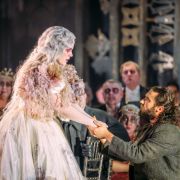
“Visually, I don’t need to dazzle,” Pizzi writes in the programme book. “By working through subtraction, I try to eliminate everything that seems superfluous and make room only for the essentials.” Those essentials are visually striking, if austere. Pizzi’s set is a black box, the back wall sliding apart to reveal a staircase. The Hebrews are dressed in black and white, the Babylonians in black and red, apart from Nabucco who, when struck by insanity, is garbed in purple. Abigaille and her guards wear leather shorts and long open skirts, with tapered helmets which make them resemble birds of prey.


Action is symbolic, often stylised. A giant menorah is toppled oh so carefully by the Babylonian guards and when the golden idol topples, it does so swiftly and neatly, without a hint of a crash or rubble: swift, clean, efficient. It’s a staging that has a clinical feel, but misses the heart of Verdi’s opera.
Instead, the pulse is provided by the singers, not least the outstanding Coro del Teatro Regio di Parma, prepared by Martino Faggiani, who sang the emblematic hymn “Va, pensiero” with soft beauty. With scrupulously observed dynamics and its long lines moulded in Francesco Lanzillotta’s hands, it was staged simply, the chorus standing to face the audience, hands behind their backs, finally falling to their knees during the final bars. Lanzillotta’s conducting throughout was considerate, the famous overture sturdy, at the expense of volatility, the playing of the Orchestra del Teatro Comunale di Bologna polished.

Two fine singers led the cast. Mongolian baritone Ariunbaatar Ganbaatar offered plenty of bite as the biblical King Nebuchadnezzar, with an expressive vocal snarl and lip curl to match his animated portrayal. His Act 4 prayer was distinguished, with long legato lines, while the ensuing cabaletta was gutsy, if lacking a little firepower.


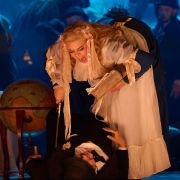
There was plenty of fire from flame-haired Russian soprano Lidia Fridman whose Abigaille ignited the staging. Her range is impressive, including scything top notes and an imposing chest voice. She sang classily in the aria “Anch'io dischiuso un giorno”, despite having to dispatch much of it lying down, and added tasteful ornaments in the second verse of her “Salgo già del trono aurato” cabaletta. Her Act 3 duet with Ganbaatar was the highlight of the evening, two powerful singers, dramatically expressive.

As Zaccaria, Parma-born basso cantante Michele Pertusi was cheered to the rafters by his home crowd. Although he retains his stage charisma, his voice is now grey and frayed at the edges, intonation variable. Tenor Andrés Moreno García was a plucky Ismaele, while mezzo Laura Verrecchia was plagued by a coughing fit before (and during) “O dischiuso è il firmamento”, somehow making it to the end intact.