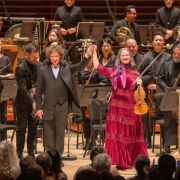
At any other Philadelphia Orchestra concert, the long-awaited debut of conductor Santtu-Matias Rouvali would have been the news. But this weekend’s program also featured the return of Hilary Hahn to the stage after a six-month break to address persistent injuries, and the beloved violinist received a hero’s welcome as she strode out from the wings of Marian Anderson Hall. Hahn and her adoring public seemed to breathe a collective sigh of relief that she was there – finally pain-free, as she wrote in a note posted earlier in the week on her website – and ready to get down to the tricky business of Prokofiev’s Violin Concerto no. 1 in D major. No surprise here: it was like she never left.

Prokofiev requires not just a dextrous technician but an artist who can shift moods on a dime. Hahn fits that bill down to the ground. She soared above the whispering tremolo of low strings during the elegant opening of the Andantino, contemplative but never ponderous. Yet to use the composer’s word, the mood doesn’t remain ‘dreamlike’ for long, and Hahn effortlessly charged into the jagged, agitated waters that followed. Her sound sometimes turned abrasive, even unpleasant as it fought the pizzicato cellos and sneering flute as the movement progressed. But then it returned to serenity for the conclusion – followed by humorous insouciance in the Scherzo and the vigorous march to silence in the Moderato.
Hahn has been living with this concerto for decades, but one of the pleasures of classical music is the opportunity to witness an artist discovering new paths on well-trod ground. That sense permeated the performance here, aided by Rouvali’s juicy orchestral accompaniment, generously laden with rubato. And it extended to Hahn’s encore, the Tempo di Borea from Bach’s Violin Partita no. 1 in B minor.
On his own, Rouvali proved more variable. The opening section of Tchaikovsky’s Capriccio italien lacked much of the irony and tension needed to balance the playful, folk-infused buoyancy that follows. The music sounded on surer footing as it progressed, particularly in the tangy contributions from the horns, but the overall quality often seemed merely like a bagatelle, rather than a work that employs joyous overstatement to mask deeper, more complicated feelings.
Shosktakovich’s Symphony no. 6 in B minor started out on unsteady footing. The composer nods to Mahler in the extended first movement, his themes passing among the orchestra in occasionally illogical ways, tempos shifting and harmonies sometimes unbalanced. Despite much beautiful playing – especially from the flutes and piccolo – Rouvali’s languid pacing and sometimes imprecise cueing turned matters tedious. The brief, boisterous movements that followed allowed a sense of shock and awe to prevail, and this listener couldn’t help but marvel at the mighty brawn of the Philadelphia Orchestra when deployed at full force. As with the Tchaikovsky, though, it was a performance of shallow brilliance rather than real depth.