At the beginning of the 19th century, the small Venetian theatre San Moisè became a centre for the farsa, a genre of short, semi-serious one-act operas performed by a small ensemble of six or seven singers, without a chorus, and accompanied by a small orchestra. Over the course of three years, the young Gioacchino Rossini wrote five farces for the theatre, including La scala di seta, which premiered in 1812. Its overture was particularly innovative for its time, beginning with a rapid cascade of violins that introduces a lyrical oboe melody before launching into a brilliantly fast theme that would become characteristic of Rossini’s style. Although the opera itself soon disappeared from the repertoire, its overture has remained a popular concert piece.

The plot follows the light-hearted intrigues typical of the genre: a soprano has secretly married an impoverished tenor and they must invent a series of schemes to keep their marriage hidden while evading the wealthy suitor chosen for her by her guardian. Despite its simple and playful storyline, the music is considerably more sophisticated, combining intricate ensemble passages with a lyrical tenor aria and an elaborate scene and aria for the soprano. These musical features foreshadowed elements that would later become characteristic of the opera seria tradition.

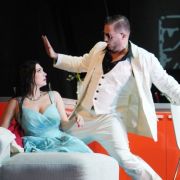
This year, the Rossini Opera Festival in Pesaro presents a revival of Damiano Michieletto’s successful 2009 production, presenting the usual contradictions that arise from transporting the story to contemporary times (it is simply not credible today that a young woman would be forced to marry any suitor chosen by her guardian, to the point of having to marry the man she loves in secret). Paolo Fantin’s sets represent the protagonist Giulia’s apartment, which is laid out on the stage floor with indications of windows, doors and furniture. During the overture, stagehands physically add pieces of furniture to the different rooms, while an architect or surveyor directs the work, blueprints in hand. The characters are carried onto the stage like props, coming to life with the music. A giant mirror, tilted at a 45-degree angle above the stage, provides an overhead view of the apartment and helps clarify the action. The singers acted with commitment and fully embraced the staging, pretending to open non-existent doors to enter rooms and even banging their heads against non-existent walls. The result was engaging and entertaining.

The orchestra of the Teatro Comunale di Bologna gave a spirited and stylish performance, with Iván López-Reynoso conducting with intense energy and just the right amount of fizz. Some of the ensembles were not entirely polished, most noticeably the quartet “I voti unanimi, la tenerezza” in Scene 7, although this may well improve over the course of the run.
Paolo Bordogna was Germano, Giulia’s servant and motor of the action, a typical buffo bass-baritone role that allowed him to display his instinctive comic flair. In Michieletto’s vision, Germano is inspired by an Italian television character: a Filipino house cleaner who was popular in Italy in the early 2000s. His characterisation is at times stereotypical, but Bordogna consistently managed to make it work on the right side of comedy. The role also requires considerable vocal qualities, and here Bordogna seemed less at ease than in recent appearances – perhaps simply a bad night or premiere nerves. His legato, in particular, did not seem entirely secure, with very slight intonation issues, although his contributions to the ensembles were precise and stylish.

Giulia was sung by Hasmik Torosyan, whose soprano was full-bodied, coloratura precise and her interpretation spirited. The voice tended towards a metallic quality in the middle register, but she had firm control of the passaggio to a pleasant and secure upper register. She also produced a splendid pianissimo high note in her grand aria. Her secret husband, Dorvil, was sung by Alasdair Kent, whose tenor could be described as tenore di grazia: light and naturally high. His impressive high notes occasionally revealed some difficulties with the emission, causing the voice to become slightly disorganised, while his coloratura was not always as crisp as it should have been. Nevertheless, his performance was enjoyable overall, and he did a very good job in his great aria, “Vedrò qual sommo incanto,” at the end of Scene 6.

Blansac, the wealthy suitor, was sung by Iurii Samoilov, who perfectly embodied the arrogant, self-assured womaniser. His smooth baritone and charismatic stage presence made for an effective characterisation. Mara Gaudenzi, as Lucilla, Giulia’s cousin, was arguably the finest voice of the evening. Her mezzo-soprano was velvety and bronzed, and her portrayal of the love-struck young woman was genuinely funny, particularly in her attempts to seduce Blansac. The cast was rounded out effectively by Enrico Iviglia as the tutor Dormont, whose lyrical tenor was pleasant and whose style was admirable.