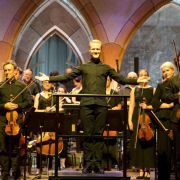
Every operagoer of a certain age knows exactly how La traviata “should” sound, a knowledge gleaned from years of listening to favourite recordings and attending some of the hundreds of performances staged each year. Generally, the reality falls short, but at last night’s Garsington’s season opener, their Artistic Director Douglas Boyd and the Philharmonia Orchestra repeatedly hit my “this is how it should sound” button.

It started from the first evanescent violin notes of the prelude, hanging in the air, then the brightness of the rhythm that appears underneath – still light, the accents marked but not forced – and the outburst of conviviality as the music’s presage of Violetta’s death switches to the exuberance of the party she is throwing. The pattern carried on from there – I’ll just name a few more instances: a brindisi infused with freshness and vigour but never over-weighted; Violetta’s outburst of “Amami, Alfredo”, preceded by a huge orchestral swell where Boyd took his foot off the accelerator at the perfect time to allow Madison Leonard’s voice to power above it; perfectly judged oboe solos interleaved with the voice in “Addio del passato”. The list could go on.


Louisa Muller’s direction had the same feeling of rightness, not least because of its attention to the finest of details. Every line sung was accompanied by body language to enhance it; every character played their part in the drama whether singing or watching the action from the background: Oleksiy Palchykov was the picture of bewilderment as Alfredo is unable to process the reality of Violetta’s departure and his father’s blandishments; Chuma Sijeqa’s Baron was a picture of jealous fury as he watches the brindisi, Henry Waddington’s Dr Grenvil stoic as the only person in the room who understands that Violetta’s sudden burst of energy is just something that happens when consumptives are about to die.

Muller doesn’t add many large items to the scenario of the standard stage directions, but where she does, they have impact. The prelude opens with Violetta (or presumably her ghost) watching a freeze-frame of her deathbed, from which she drifts to another freeze-frame of her party, which comes to vibrant life at the change in the music. The carnival festivities in Act 3 don’t just sit outside Violetta’s window: they invade her bedroom and surge through her fevered mind.

Christopher Oram’s designs are intelligent and effective. A large revolve shifts us smoothly between the blue-grey and white marbled ballroom, corridor and bedroom of Violetta’s elegant Paris apartment in Act 1; lighting and a few scraps of furniture switch us to her country residence in Act 2; after the interval, vivid lighting and drapes announce that we’re at Flora’s fancy dress party, which is a splendidly tackier affair (Alfredo’s Roman legionnaire costume or d’Obigny’s drag queen outfit would decidedly not have been seen in Act 1 at Violetta’s. Oram’s costumes are pure eye candy, moved forward in time, perhaps to the 1920s.


I could probably ask for a warmer natural timbre in both Leonard or Palchykov’s voices. But in terms of musicianship and utter commitment to their roles, both turned in performances of the absolute finest. Again, a few examples: Leonard almost spitting the word “giammai” (never) into the face of Alfredo, then executing an impossibly daring pianissimo for “Dite alla giovine” as she enjoins Germont to tell his daughter her story when she is gone. Palchykov delivered effortless highs and good cheer in the brindisi (together with a fine bit of blindfolded cocktail-making). Both combined excellent intonation with just the right amount of vibrato; both judged their accents well to match what was coming from the orchestra. Roland Wood was a powerful Germont, with every word intelligible and a distinct touch of brutality concealed within a smooth timbre – an iron fist in a velvet glove.

In a work the size of Traviata, conductors and singers have hundreds – maybe thousands – of decisions to make in the course of a performance, choosing to adjust rubato, dynamics, balance, vibrato, accents, tone of voice. I cannot remember the last time I saw a performance in which such an overwhelming number of those decisions seemed felicitous. I hadn’t imagined that it might be possible to experience the thrill that I felt when I heard La traviata for the first time, over sixty years ago. But that’s what happened last night.