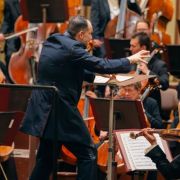
The Gewandhausorchester Leipzig’s most recent appearance at the Musikverein, under Andris Nelsons with pianist Yulianna Avdeeva as soloist, offered a rare reminder of what orchestral performance can be when virtuosity is fully subsumed into musical purpose. There was no trace of spectacle for its own sake, no cultivated theatricality, only an extraordinary level of collective concentration, a shared commitment to the work that rendered the evening both intellectually compelling and viscerally immediate.

Avdeeva’s account of Rachmaninov’s Second Piano Concerto emerged from a place of grounded authority from the very first bars. The opening, so often treated as a prelude to pianistic display, was instead shaped through remarkable bass warmth and tonal anchoring that immediately established her interpretive stance. While many pianists race to play the softest, she cultivated a full-bodied, centered tone that allowed the concerto’s eternal lines to unfold with structural clarity. What proved most striking was her command of large-scale architecture. Rachmaninov’s notoriously expansive phrases were neither indulged nor rushed, but articulated with a sense of inevitability, each dynamic contour and inner voice calibrated with evident deliberation. Her voicing choices – particularly in the dense chordal passages of the first movement and the intricate filigree of the Intermezzo – revealed an acute awareness of the concerto’s polyphonic tensions. At no point did she relinquish control; even in the most virtuosic passages, the technical demands seemed fully integrated into an overarching musical argument.
Equally compelling was the unspoken dialogue between soloist and conductor. Nelsons proved an ideal partner, shaping textures with flexibility and precision, allowing Avdeeva both space and support. Their coordination in transitional passages, especially the shifting tempi and rubato interplay of the first movement cadenza and the finale’s driving rhythms, suggested a deep level of mutual attentiveness that transcended mere coordination. Avdeeva’s stage presence was undeniable. Without resorting to overt gestures or performative display, she commanded attention through sheer innate charisma, anchored in her intense engagement. Her encore, a sharply characterized Shostakovich Prelude (D flat major), was delivered with sardonic wit, providing a concise epilogue before she quietly rejoined the hall as a listener for the second half.
The Gewandhausorchester’s account of Shostakovich’s Tenth Symphony further demonstrated their abilities. The opening Moderato unfolded with a dark, expansive breadth, the strings producing that unmistakable Gewandhaus timbre: warm, mahogany richness underpinned by a finely balanced inner texture. Nelsons maintained taut structural lines across the movement’s vast span, ensuring that its cumulative intensity never dissipated. The Allegro, Shostakovich’s brutal portrait of Stalin (or how it’s often understood) was delivered with ferocious precision. Rhythmic articulation was razor-sharp, the orchestra fully committed yet never chaotic, allowing the movement’s energy to register with clarity rather than sheer volume.

In the third movement, the interplay between the D-S-C-H motif and the horn’s lyrical calls (notably executed with striking poise) created a texture of uneasy lyricism, suspended between introspection and coded defiance. It was in the finale that Nelsons’ interpretive command was most evident. The pastiche-like reintegration of earlier material can easily feel episodic; but unfolded here with remarkable coherence. Nelsons navigated its abrupt shifts in tempo and character with ease, as though tracing a narrative he himself had authored. The gradual emergence of the D-S-C-H motif into the symphony’s closing affirmation was handled with structural intelligence and expressive restraint.
Throughout the evening, what remained most remarkable was the collective focus shared by all performers. The Musikverein, filled to capacity, responded in kind: the usual undercurrent of restlessness replaced by rapt stillness. Time seemed to contract; the concert’s substantial program passed with an immediacy that seemed impossible. It was a sustained, deeply considered act of music-making in which every participant – soloist, conductor, orchestra – was wholly present; these are musical experiences which truly linger.