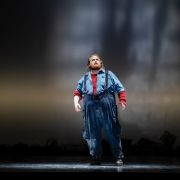
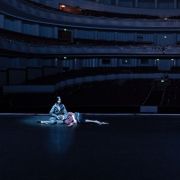
Is theatre another spectator sport? What does it feel like to watch something unfold in front of you? This seemed to be the central question of English National Opera’s Angel’s Bone in an extraordinary new production in Manchester by Kip Williams. With spectators spread around a circular, constantly rotating stage, we stare at the rapidly unfolding horror as two innocent angelic beings are unceremoniously dumped into the empty, pointless violence of televised domesticity – to watch them be destroyed for no reason other than the softness of their feathers.

Composer Du Yun and librettist Royce Vavrek originated Angel’s Bone in 2011, expanding it to 85 minutes in 2016. The music is all-encompassing: dissonant, rhythmic, varied, though throughout the presence of a chorus is crucial. In this production, Kantos Chamber Choir are present more or less constantly, initially as a chorus of angels, with singing reminiscent of medieval organum, and then as a crowd of odious partygoers and obsessed fans. They revel, yelp, shag, snort cocaine, throw sandwiches about, piss up the walls, vomit into bins, and generally make spectacles of themselves, which is the point.


Also crucial to Williams’ production is the presence of several steadycam operators, whose live video feeds are broadcast to four large screens positioned around the stage. The effect of this is profound. Throughout, the performances of the central characters – wife and husband Mrs and Mr XE, sung with fearsome brilliance by Allison Cook and Rodney Earl Clarke – are performed in televised close-up, tiny eye and facial movements directly and immanently visible in a way normally impossible in theatre.

The same is true for the two angels, Matthew McKinney and Mariam Wallentin, whose performances are no less terrifying: abused, wounded, stripped of their hope and self-worth. Captured and broadcast on camera, they are able to emote with the directness and simplicity of film acting. As the stage revolves, audiences are able to see these performances emerge in front of them, viewing alongside the steadycams, which bustle around the stage together with a corps of stagehands, constantly shifting the various parts of the house set, designed ingeniously by Marg Horwell.

This production seems especially concerned with the phenomenon of television, mentioned explicitly in the libretto. The vibe is reminiscent of the golden age of reality TV at the turn of the millennium. In her half empty IKEA-showroom house, Mrs XE smokes indoors and chops courgette, telling her husband that she doesn’t love him, while he wanders around drinking vodka. Quickly after discovering the angels, they begin to strip their wings for no other reason than they are entranced and bored. Mrs XE doesn’t take photos of the angels on a smartphone; rather she invites friends round for a party to show off her new bounty of miraculous feathers. Only at the end do smartphones emerge in earnest, as the now angelically pregnant Mrs XE stands on a table and shows herself off to a crowd of phone cameras.


But why have the angels been sent into this world, this “clawfoot Eden” as they describe it? Others have made connections between this opera and human trafficking but, at least in this production, it seems that the angels are sent – by heaven, or by the authors – precisely so we may observe what human beings are capable of doing. Heaven wishes to observe the brain-emptied, casual violence of home-owning domesticity, of hedonistic boredom. Male soprano Keith Pun stands as an angel at the edge of the action, observing his compatriots’ suffering with a mixture of concern and studied indifference.

The Boy Angel’s pleas for recognition, in McKinney’s haunting tenor, are heard but largely unrecognised. Later, the Girl Angel sings a no-wave-esque song with righteous fury to the assembled partygoers, who lounge on chairs absentmindedly retching. One member of the chorus seems to offer the angels some concern: in a solo, chorus member Camilla Seale approaches the Boy Angel with great, lyrical tenderness – before shortly resolving to kick him in the ribs.

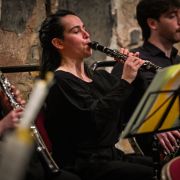
Musical performances from all the cast and chorus, and the BBC Philharmonic chamber ensemble, conducted by Baldur Brönnimann, were excellent – notably an extraordinary oboe solo from Christopher Redgate. Technical aspects and sound mixing were similarly excellent throughout. When it opened several years ago, there was some question as to what Aviva Studios should really be used for. It turns out it is the perfect venue for this kind of audacious, virtuosic production, which would be difficult to mount without the state-of-the-art equipment and expertise on offer here. If the quality of Angel’s Bone is a herald of what Manchester can expect from hosting ENO, then the city should be justly proud of itself.