

Australian soprano Lauren Fagan is no stranger to UK audiences. A former Jette Parker Young Artist (2014–16) with The Royal Opera, she’s also performed at Glyndebourne, Opera North, Welsh National and Scottish Opera. And who can forget her haunting Violetta for Opera Holland Park? But Fagan has just returned to these shores to make her English National Opera debut in the UK stage premiere of Kaija Saariaho’s powerful Adriana Mater, a story about a passionate young woman who is raped, but decides to keep the baby.

When we catch up, Fagan has just returned from Toronto, singing Fiordiligi in Così fan tutte for the Canadian Opera Company. Quite the stylistic leap, I suggest. Was it dangerous to be preparing the role of Refka, Adriana’s sister, while simultaneously singing Mozart?
“It depends on the voice,” she begins, “but for me, it's absolutely dangerous, especially in a role like Fiordiligi which is at such extremes, sitting at these two different tessituras. I didn't really sing Adriana Mater much at all in Toronto because it was such a contrast. But used the daytimes to study this new role – my first experience of doing something completely in my head! I was speaking the text down an octave and basically it was about getting the rhythms and these really difficult intervals.”
Fagan has had a most useful study tool: the Deutsche Grammophon recording conducted by Esa-Pekka Salonen which just won the Opera category in the Gramophone Awards. It features Axelle Fanyo in Fagan’s role, plus Christopher Purves as Tsargo (Adriana’s rapist)... both of whom are currently singing in ENO’s new Tosca, which has been conceived by director Annilese Miskimmon as a sister production to Adriana Mater. A remarkable coincidence.


“Because we are doing it in an English translation rather than the original French, I didn’t rely too much on the recording,” Fagan explains, “Obviously, Axelle and I have different weights of voice, but it did give me an idea of Saariaho’s soundscape which is so different to hearing it on a piano in the rehearsal room. Although I listened religiously to Axelle, it was always while doing my English translation with its different rhythms.
“Although I can speak German now, living in Vienna, and a little bit of Italian, the chance to sing in English is a wonderful thing. We’re constantly singing in languages which we haven't grown up speaking, so there's this other layer of trying to make sure you’re translating exactly what you’re singing, putting the right phrasing, all the kinds of stuff which, in English, I don’t have to think twice about. The text is so much easier to deliver. I can put my meaning behind the words straight away. No one can say, you’re doing it wrong. It’s refreshing once in a while to be a master of the words you’re singing.”
Saariaho’s vocal writing in Adriana brings different challenges. “She uses a lot of Sprechgesang which I’d never done before, so that's been really cool in itself, learning how to do it safely. I was totally freaked out by it at first, so I messaged Axelle to ask how she went about learning it. Is it meant to be on pitch? Is it meant to just be spoken? She told me just to take time with it. Repetition, repetition, repetition!”

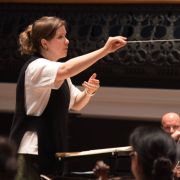
“We actually had the luxury of two weeks purely working on the music. It’s been amazing because we’ve got Aliisa Neige Barrière, Kaija's daughter, with us. She’s conducting the final two shows. Obviously, she is really protective and knows the opera inside out, so initially I was nervous to sing this in front of her, but she's really given me more flexibility and more freedom than I expected, making it work for the English inflections rather than what was written in French. Even with the translation by Aleksi Barrière [Saariaho’s son], who was with us for two days, we’ve changed things. I’ve done some opera in translation where the English has felt more like a hindrance, but this one just makes so much sense. Aleksi has used a poetic language that I guess comes from the French.
“André de Ridder [ENO’s Music Director Designate] has already had a session with the orchestra and they were really on top of it already – it’s a great piece for this orchestra. Already the role is feeling like my own. It's a world premiere, in a way, of this English version.”
Adriana Mater faced a difficult reception when it premiered at the Opéra Bastille in 2006. Saariaho had strayed from the ethereal quality of her first opera, L’Amour de loin, in setting a story rooted around a violent act. Aleksi Barrière has since written that “the most misguided and at the same time most illuminating grievance that has been formulated about this work is that it is a symphonic oratorio rather than an opera.”

Miskimmon’s creative team are producing Adriana Mater as a sequel to their Tosca. “I’ve just seen the set of Tosca,” Fagan reveals. “There’s a 1980s concert-hall vibe which gets destroyed, like art is being destroyed. When we take over the country is in the throes of a civil war.”


Act 2 takes place 17 years later when Yonas, Adriana’s son, has grown up and he vows to kill his rapist father. “The production will use the same hall, to show how things can slowly rebuild over time. I can already feel how emotionally draining this role is going to be. With only the four of us in the main roles, it's very intense and intimate considering the sensitive themes that we're dealing with.
“I think having these two shows linked will be a good way to bring people who maybe want to see Tosca, because they’ve heard of that title, to see Adriana Mater too – a gateway to bringing more people to modern opera.
The biggest contemporary opera role Fagan has undertaken so far was Agnès in George Benjamin’s Written on Skin. “I loved doing Written On Skin!” she exclaims. “I will never forget it. Even ten years later, it’s still there in my brain.”
“At first, it was so terrifying,” she explains, “But I dedicated myself to the cause and spent hours each night marching around my room, getting this music into my body. It became so deeply ingrained because we were again putting it together in just one week before taking it to the Mariinsky and then to LSO St Luke’s. It was one of the most rewarding productions I’ve done. I think this one is going to be similar because with modern music you're not comparing yourself against 50,000 other singers. You have the freedom to embody it, to make it your own, find your voice the way that you’re going to sing it.”
Last summer, Fagan made her title role debut in Samuel Barber’s Vanessa at the festival founded by Gian Carlo Menotti in Spoleto. “Leo Muscato, who was the director, created a beautiful production. Vanessa is a dream role. Dramatically, she’s so deluded! It was bizarre to sing somebody who is older. I was really aged up because Kayleigh Decker, who sang Erika, is only a few years younger than me.”

Another role debut last season was Rusalka, for Royal Swedish Opera. “It fits my voice like a glove,” she enthuses. “From start to finish, it was perfect. It went up high where I would love to go up high, and really sat in the middle part of my voice, which is where I'm most happy. Of course, I've got low notes, I’ve got high notes, but I don't want to sit around there all the time… which is what Fiordiligi does! In Act 1, there’s the Song to the Moon, which is quite floaty and silvery and really gives the worst possible representation of the role of Rusalka! It’s way bigger!”
Fagan has also made forays into Wagner – Gutrune in Zurich, Woglinde at Covent Garden and a Third Norn coming up in Munich – and she tantalises me with news of a big role debut as Elsa in Lohengrin. But for now, it’s Saariaho in London. I ask what it means to be making her company debut with ENO. “I definitely wanted to come for the right role,” she replies. “Although I’m a proud Aussie, I’m very British trained in the opera sense, so it feels like a kind of a homecoming in every sense of the word.”
Lauren Fagan performs in English National Opera’s Adriana Mater from 28th November at the London Coliseum.
See upcoming performances by English National Opera.
This article was sponsored by English National Opera.