How do you solve a problem opera like Pietro Mascagni’s Iris? I can think of several opera companies that, fearing charges of cultural appropriation, would run a mile from the sordid tale of the Japanese girl abducted into prostitution who, rejected by her blind father, throws herself into a sewer. As a plot, it stinks. But the Teatro Regio di Torino doesn’t shy away from the challenge and director Daniele Menghini solves the “problem” by not treating it as a problem opera at all, instead offering a sensitive, sympathetic staging, part of its Verismo Festival.

Menghini and his creative team draw inspiration from the Hibakujumoku, the trees that somehow survived the Atomic bomb radiation in Hiroshima and Nagasaki and inexplicably began to blossom once more amongst the ruins. The character of Iris symbolises this regeneration. Oppressed by violence and the desire for possession, she is a flower that blooms in the societal wasteland.


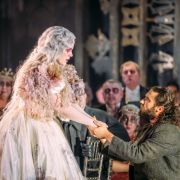
In this apocalyptic landscape, the head of a brass Buddhist statue lies among the rubble. A willowy, priest-like figure, played with ghostly fluidity by choreographer Marco Caudera, lights lanterns before a huge tarnished gong, a ritual of times past, is raised to represent the sun in the famous opening chorus, a Hymn of the Sun that gets the opera off to a thrilling start. Iris tends her garden of origami flowers, caring for her blind father, who is dressed in traditional long white robes. A doll is Iris’ emotional refuge. All the other characters – Osaka, the prince who lusts after her, Kyoto, who runs a brothel, and the chorus – wear masks, as if hiding the scars of past atrocities.

During a puppet show, a tea ceremony is depicted. The tea is drugged, which is how Iris is abducted into prostitution. Act 2 takes place in the remains of a geisha house in Yoshiwara, a notorious red-light district, where Kyoto, dressed as a woman, runs his business. An octopus mural represents the lust in the erotically-charged dream Iris sings about. Whether we need to see the octopus embodied on stage during Iris’ aria is debatable, Menghini’s only (slight) misstep. Davide Signorini’s set then rises spectacularly to reveal Kyoto’s captive geishas, allowing Iris, up high in a balcony window, a Tosca-like leap.

Menghini’s final act is a dramatic masterstroke. During the prelude, a life-size doll represents Iris’ fall, tended by the priest and laid gently on the ground, where Iris appears. Giant geisha puppets with disembodied heads haunt her, as do visions of the opera’s male characters among the rag-pickers, before a sunflower magically blooms in the wasteland, triggering a transfiguration during which the priest carries Iris away while a cascade of sunflowers descend from the flies prompting a reprise of the Hymn of the Sun. It’s tear-jerking stuff.


Parallels are sometimes drawn between Iris and Madama Butterfly, but Mascagni’s opera predates Puccini’s by half a dozen years, satisfying Italian appetites for giapponismo at the turn of the 20th century. A year after its 1898 premiere in Rome, it arrived at the Teatro Regio. In 1963, celebrating Mascagni’s centenary, it was staged here with Magda Olivero in the title role.

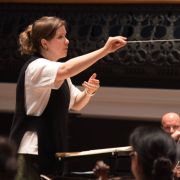
For such a sordid plot, the music of Iris is sumptuous. The orchestral writing is lush and, in the cavernous Teatro Regio pit, athletic Music Director Andrea Battistoni drew a full-bodied sound from his orchestra, holding nothing back.
In the title role, Erika Grimaldi, possessor of a peaches-and-cream lyric soprano, was occasionally overwhelmed by Battistoni’s enthusiasm but sang with radiance and purity of line. Her ‘aria della piovra’ (Octopus aria) was sung sensuously, while her death scene was beautifully played. Angelo Villari’s bruising tenor suited Osaka’s brutal character, a nasty man who makes Butterfly’s Pinkerton look like a saint. Villari’s made a thrilling sound, hurling himself at top notes, and dispatched his little serenade “Apri la tua finestra” with ardour.

Experienced baritone Roberto Frontali was a lascivious Kyoto while Luca Tittoto lent his firm bass to Il Cieco, Iris’ blind father. The Teatro Regio chorus framed the opera gloriously, its final contribution during the radiant transfiguration simply jaw-dropping.