Along with attempts to demonstrate that Pietro Mascagni and Ruggero Leoncavallo were more than one-hit wonders, the Teatro Regio di Torino’s Verismo Festival also featured the double-bill pairing that both composers hated: Cavalleria rusticana and Pagliacci. Intriguingly, the stagings are by different directors – Daniele Menghini (who directed Mascagni’s Iris) and Francesco Micheli (who directed La bohème) – but the same set designer, Davide Signorini. So, a shared concept or wildly different approaches?

Cavalleria rusticana has a very specific setting – a Sicilian village on Easter Sunday – and Menghini duly obliges, with the villagers putting on an Easter passion play. But Pagliacci has a specific setting too, although not one, I’d hazard, that is widely known, nor does it play a crucial part in the action: the Feast of the Assumption (Ferragosto) on 15th August. Setting both operas within a liturgical context offers a pleasing sense of unity.


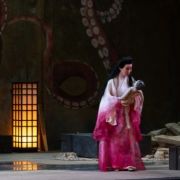
Signorini’s set features a series of performance platforms on a revolving stage. It works particularly well for Cav, where we see the villagers manipulating the scenery for their Easter story, with Turiddu painting the sets. Golgotha and the tomb are central, but there’s also a sacrificial lamb, the Garden of Gethsemane, where Santuzza reveals the truth to Alfio about his wife’s affair with Turiddu, and the Last Supper for Turiddu’s brindisi in the tavern scene. The set is topped by a crown of thorns. Statues of the Madonna and a golden-winged St Michael are placed on pedestals, the latter coming to life during the Intermezzo, offering Santuzza a lily of redemption. Everyone is in traditional Sicilian or Easter costume, apart from Santuzza who, excommunicated, is not permitted to participate. As a production, it works brilliantly, with Menghini directing his cast and chorus so that the action flows smoothly.

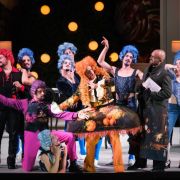
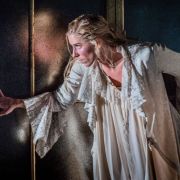
In Pagliacci, the revolving platforms are largely bare, with more of the action based on the winged donkey chariot – cue cuckolding motifs – on which Canio and his troupe arrive, which also acts as a backstage dressing room. The players are a wild, animalistic bunch, with Canio dressed as a liontamer, Tonio in green reptilian leather and Nedda as a white peacock showgirl. The Virgin Mary statue is present again, mimicked in Nedda’s Columbine costume for the clowns’ show. Extras from Micheli’s Bohème are back, although less distracting here. Their knife-juggling circus act entertains both the village audience and those of us in the theatre. Ariunbaatar Ganbaatar sings the Prologue from the Stalls, dressed in white top hat and tails. He is the real ringmaster of this show.

The only moment that doesn’t quite work is the Pagliacci finale. As Canio breaks the fourth wall and flies into his jealous rage, his attack on Nedda is oddly stylised and then her Madonna-like white mantle parts to reveal a pleated red skirt, representing blood, while Silvio, dressed as an angel, adopts a prayerful pose next to her: it is all part of the act – we have all been hoodwinked – and they all leap up to take their stage bows to the villagers.


Both operas were impressively cast. Leading Cav was Ekaterina Semenchuk’s powerful Santuzza, fiercely sung, with striking top notes. After making heavy weather of the off-stage siciliana in the prelude, Angelo Villari’s hot-tempered Turiddu sang with fire. Elena Zilio still rocks the stage as Mamma Lucia, her sympathetic stage presence and distinctive mezzo a force to be reckoned with.
In Pag, tenor Martin Muehle was a terrifically wild Canio, delivering a stonking “Vesti la giubba”. After a cloudy “Stridono lassù”, Carolina López Moreno’s Nedda warmed up for a passionate duet with Joshua Hopkins silky Silvio. Matteo Mezzaro was an urgent Beppe, a fuller tenor than often heard in this “light” role. Ganbaatar was the only singer to grace both casts, an amiable Alfio, goaded into jealousy, while his Tonio was a particularly slippery character. He sang the Pagliacci Prologue with panache, rich-toned and vividly acted.

Andrea Battistoni conducted with plenty of rubato, which occasionally caught out his singers, especially the clumsy tempo shifts in Alfio’s “Il cavallo scalpita”. The Orchestra of the Teatro Regio is extremely fine and their committed playing certainly added to the drama of this double bill, proving that – for all their composers’ objections, Cav & Pag remains a potent pairing.