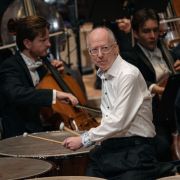
As one of the highlights of Schleswig-Holstein Musik Festival, the Royal Stockholm Philharmonic Orchestra’s concert opened with Mendelssohn’s Overture to A Midsummer Night’s Dream, performed here as a seasonal greeting to Hamburg. Under Ryan Bancroft’s direction, the performance unfolded at a notably steady pace, focused on bringing out inner voices and highlighting low-string lines. While this approach created a fresh sonic world, the overall impression leaned toward polished smoothness and delicate beauty, slightly blunting the endless youthful imagination of the teenage composer's sheer genius.

The mood brightened considerably with Glière’s Harp Concerto in E flat major, perhaps the most anticipated work of the night. Written in 1938, the piece feels completely out of step with its time, seemingly unconcerned with the political turmoils of its era; in fact, its Romantic warmth could feel equally at home in 1838. It stands out as an outlier – reminiscent of Richard Strauss’ late operas written amid wartime gunfire, though filled with a bright, spring-like optimism rather than Strauss’ autumnal nostalgia.


Xavier de Maistre’s performance challenged the stereotype of the harp as a purely coloristic instrument. His playing featured extraordinarily clean lines and crisp articulation. He transitioned effortlessly between melodic solo passages and rapid arpeggio transitions. In the thematic sections, his sound carried incredible projection; even in the harp's high register, where notes decay quickly, his phrasing remained remarkably lyrical. Reduced to a near-chamber scale, the RSPO provided ideal support, allowing this elegant and lively concerto to blossom. Rewarded with enthusiastic applause, de Maistre treated the audience to an extended encore from Manuel de Falla's La vida breve.
If the first half offered direct beauty, Allan Pettersson’s Seventh Symphony presented an ultimate test for both players and audience. Spanning 50 minutes without pause, the work functions largely as a single, massive slow movement. Its dark mood strongly recalls Shostakovich, seasoned with the elusive, interior detachment of mid-period Vaughan Williams. The dense orchestral texture moved like a heavy armour, driven by prolonged, intense tugs-of-war between high violins, deep basses and heavy brass. As soon as one exhausting section drew to a close, another began, demanding sustained emotional energy from the listener. It felt like a Scandinavian cousin to Mahler’s Fifth, Shostakovich’s Fourth, or Walton’s First – a hardcore monument that exacts a heavy physical and mental toll.


The RSPO, which originally premiered the symphony, acted as faithful guides through this dense musical jungle. They played with heroic dedication, building toward a breathtaking moment about ten minutes from the end, the work's rare passage of sweet, serene peace. Though this beautiful light was soon swallowed by returning bitterness, its theme underwent a barely recognisable transformation, finally dissolving into the symphony’s quiet conclusion. While it commands genuine reverence that a composer in the late 1960s could still capture sustained public acclaim through large-scale symphonic works, such a massive structure reliant on a single compositional principle inevitably sets a high threshold for the listener, feeling, at times, like a solitary monologue.